
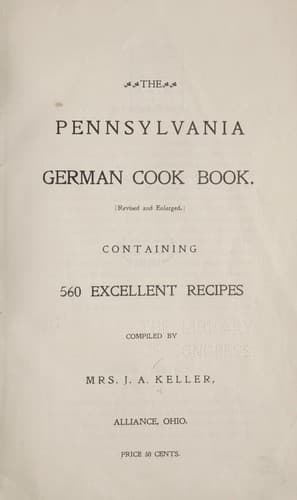
The Pennsylvania German cook book
1902Keller, J. A. Mrs · 59 readable pages · 358 recipe records · general household cookbook
From the librarian's dossier · AI-generated, grounded in the scanned text
The Pennsylvania German Cook Book (1902) by Mrs. J. A. Keller is a community-sourced collection of recipes and household advice rooted in Pennsylvania German farmhouse traditions. Compiled from contributions credited to named cooks across Ohio, Pennsylvania, Michigan, and Indiana, it gathers hundreds of recipes for cakes, cookies, breads, pies, puddings, meats, poultry, fish, vegetables, pickles, preserves, candies, and beverages, alongside sections on home remedies and household cleaning. The bulk of the book, over 350 anchored food records, reflects the everyday and celebratory cooking of a rural German-American community at the turn of the twentieth century, with an emphasis on preservation techniques such as canning, pickling, and sauerkraut-making that were essential for surviving winter months. Beyond the kitchen, the book extends into the domestic sphere more broadly, offering soap recipes, stain removal instructions, and even a weekly housekeeping schedule meant to instill order and virtue in the household. Modern readers will find this book valuable both as a culinary record and as a window into the domestic expectations placed on women of the era. It is not a polished, single-author work but a practical compilation meant for daily kitchen and household reference, mixing recipes with folk remedies and moral guidance for young housekeepers.
The book is organized into six broad sections that move from baked goods to savory cooking to preservation and finally household management. Section 1 opens with an extensive run of cakes, cookies, frostings, and bread leavening methods. Section 2 continues with breads, rolls, biscuits, and griddle cakes before shifting into pies, puddings, and custard desserts. Section 3 covers desserts like flummery and mousse alongside main courses: meats, poultry, fish, eggs, and oysters. Section 4 turns to vegetable preparation and preservation, including sauerkraut, cheese-making, noodles, and an extensive pickle and relish assortment. Section 5 closes out the food content with pickled fruits, ices and sherbets, preserves, canning instructions, candies, beverages, and a notable block of sick-room foods and home remedies. Section 6 departs from cookery entirely to cover soap-making, laundry and cleaning instructions, pest control, and a detailed appendix of daily housekeeping schedules and advice for young housekeepers. Headings throughout use period category labels (CAKES, VEGETABLES, PICKLED PEACHES, SOAP) rather than a modern index structure.
Recipes from this book
358 records extracted from the text, showing the first 50 in reading order. Each links to a modern interpretation.
Read the book
59 readable pages. A dot marks pages with recipe records.