
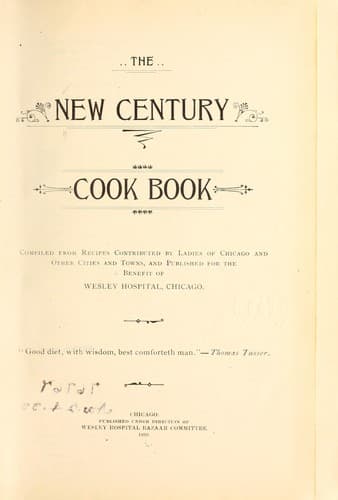
The New century cook book
1899157 readable pages · 1,017 recipe records · charitable community cookbook
From the librarian's dossier · AI-generated, grounded in the scanned text
The New Century Cook Book (1899) is a charity compilation assembled by contributors, largely women, from Chicago and other American cities to benefit the Wesley Hospital. Unlike a single-author cookbook, it gathers hundreds of tested recipes credited to named contributors, reflecting the community fundraising cookbook tradition of the late nineteenth century. The book moves through the full arc of a period household kitchen: breads and breakfast items, soups and fish, meats and poultry, vegetables, pickles and condiments, salads and dressings, eggs and light dishes, an enormous run of cakes and cookies, pies and puddings, frozen desserts and candies, and finally household hints and invalid cookery. It closes with pages of Chicago-area advertisements that place the book squarely in its commercial and civic context. With 1,017 anchored food records and only a single medicinal entry, this is overwhelmingly a cooking manual, though it also dips into home remedies and domestic advice near the end. Modern readers will find it a rich record of American home cooking at the close of the Victorian era, valuable both for its recipes and for the social portrait created by its many named contributors and its charitable purpose.
The book is organized into thematic sections that were themselves headed accordingly: breads and breakfast items (section 1), soups and fish (sections 2-3), shellfish and meats/poultry (sections 3-4), vegetables and sauces (section 4), pickles, catsups, and condiments (sections 5-6), salads and dressings (sections 6-7), eggs, omelets, and miscellaneous dishes (section 7), an extensive run of cakes spanning several sections (sections 8-10), cookies, fried cakes, icings, and preserving/canning (section 11), pies and desserts (section 12), puddings across two sections (sections 13-14), mince meat, frozen desserts and candies (sections 15), household hints and invalid cookery (section 15), and finally beef tea followed by advertisements (section 16). Recipes throughout are attributed to named contributors, consistent with the book's origin as a charitable community compilation.
Recipes from this book
1,015 records extracted from the text, showing the first 50 in reading order. Each links to a modern interpretation.
Read the book
157 readable pages. A dot marks pages with recipe records.