
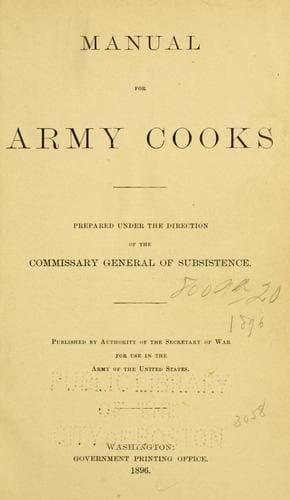
Manual for army cooks
1896United States. War Dept. Subsistence Dept. · 128 readable pages · 310 recipe records · military institutional cookbook and mess management manual
From the librarian's dossier · AI-generated, grounded in the scanned text
This 1896 Manual for Army Cooks is an official publication of the United States War Department's Subsistence Department, created to standardize food preparation across military garrisons and field camps. Rather than a book for a general household, it is a training and reference manual for enlisted cooks, stewards, and mess officers, blending practical recipes with logistics, equipment care, and sanitation. It opens with fundamental cooking methods and meat selection before moving through soups, fish, beef, pork, mutton, poultry, and game, then vegetables, grains, eggs, breads, cakes, and puddings. A distinctive feature is its attention to institutional scale and military context: recipes are proportioned for company or ration-sized batches, and separate sections address cooking in garrison versus in the field, including trench fires, portable ovens, and pack-transportable equipment. Spanish and Mexican dishes, canned goods handling, and coffee and tea preparation round out the culinary content. Interwoven throughout are duty rosters, mess fund administration, ration components, and pricing for provisioning 1,000 rations, reflecting the manual's dual purpose as cookbook and administrative guide. For today's reader, it offers a detailed window into how the U.S. Army fed its soldiers at the close of the nineteenth century, revealing both culinary technique and the bureaucratic machinery of military subsistence.
The manual is organized in two broad parts corresponding to setting: garrison cooking and field or camp cooking. It begins with general cooking methods, meat selection, and utensil care (section 1), then covers mess organization, duties, and stock-based soups (section 2), continuing through extended soup and fish recipes (section 3). Sections 4 through 9 proceed by ingredient category: beef, pork, mutton, poultry, and game (sections 4-5); vegetables, legumes, and grains (sections 6-7); breads, cakes, and puddings (section 8); and further puddings, sauces, Spanish and Mexican dishes, and beverages and canned goods (section 9). The second half shifts to field conditions: camp cooking facilities, field ovens, and portable equipment (sections 10-11); camp cookery recipes, provisioning calculations, and ration-saving techniques (section 12); and finally canned seafood, coffee and tea preparation, and a comprehensive index (section 13). Headings throughout use military terminology such as 'ration,' 'mess,' and 'kitchen police,' and recipes are frequently grouped by cooking method (boiling, baking, frying) rather than by dish alone.
Recipes from this book
310 records extracted from the text, showing the first 50 in reading order. Each links to a modern interpretation.
Read the book
128 readable pages. A dot marks pages with recipe records.