
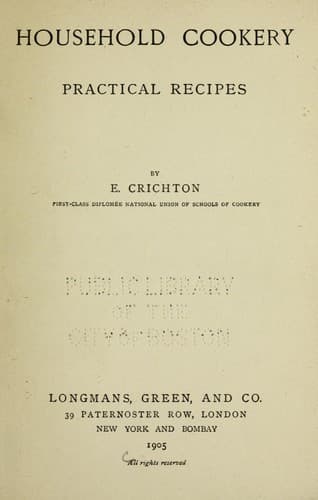
Household cookery
1905E. Crichton · 38 readable pages · 187 recipe records · general household cookbook
From the librarian's dossier · AI-generated, grounded in the scanned text
Household Cookery is an early twentieth-century practical cookbook by E. Crichton, published in 1905. It belongs to the tradition of comprehensive household manuals meant to guide a cook, whether professional or domestic, through the full range of everyday kitchen work. The book opens with foundational instruction in cooking methods before moving through soups, fish, meats, vegetables, cold meat cookery, savories, pastry, puddings, sauces, sweets, jellies, jam making, icings, and even sickroom cookery for invalids. With 188 anchored food records, it is dense with recipes and technique notes rather than narrative prose. The organization follows a logical progression that a household cook of the period would have used: master the basic methods first, then build up through courses from soup to dessert, finishing with preserving and specialized cookery for the sick. Modern readers will find it a useful window into how a turn-of-the-century household kitchen was run, what ingredients and techniques were considered fundamental, and how recipes were communicated with an assumption of prior kitchen knowledge. It is a practical reference rather than a book meant to be read cover to cover for entertainment, though its structure rewards sequential reading for understanding period technique.
The book is organized into four broad sections that move through a logical cooking curriculum. Section 1 opens with core methods of cooking (roasting, baking, boiling, broiling, stewing, frying, steaming, braising), rules for choosing meat, stock, soups, and fish and meat recipes. Section 2 covers vegetable cookery, cold meat cookery, savories, potted meats, and bread and cake baking. Section 3 addresses pastry fundamentals, pies and tarts, puddings, and both savory and sweet sauces. Section 4 closes with sweets, jellies and creams, jam making, icings, sickroom cookery, and miscellaneous recipes such as omelets and mincemeat. The headings suggest the book was meant to function as a full household reference, moving from technique to course to preservation and special dietary cookery.
Recipes from this book
187 records extracted from the text, showing the first 50 in reading order. Each links to a modern interpretation.
Read the book
38 readable pages. A dot marks pages with recipe records.