
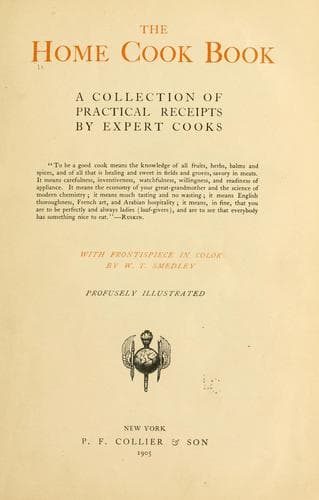
The home cook book
1905Christine Frederick · 220 readable pages · 888 recipe records · general household cookbook
From the librarian's dossier · AI-generated, grounded in the scanned text
The Home Cook Book (1905) is a comprehensive American household cookbook attributed to Christine Frederick, organized as a practical culinary reference for the early twentieth-century home. Spanning soups, fish, meats, poultry, sauces, salads, vegetables, breads, desserts, preserving, and beverages, the book anchors nearly 900 identifiable food recipes alongside a single medicinal entry. Its introduction frames a dual purpose: teaching the underlying knowledge of good cooking, including ingredient selection, technique, economy, and food science, while remaining accessible to average homemakers rather than professional cooks. The text reflects the domestic science movement of its era, with attention to market economy, use of every part of the animal, and systematic instruction in baking, canning, and preserving. Readers will find both everyday staples like mashed potatoes and bread puddings alongside more elaborate entertaining fare such as Charlotte Russe, lobster a la Newburg, and Colonial Wedding Cake. The book also documents period habits around fresh produce selection, home preservation of fruits and pickles, and beverage-making including wines, punches, and beef tea. As a period document, it offers a window into how a household cook of 1905 was expected to plan, shop, and prepare food across an entire year and across social occasions, from invalid dishes to festive cakes.
The book proceeds in a logical culinary sequence rather than strict alphabetical order, moving from appetizers and soups (sections 1-3) through fish and seafood (sections 3-4), economical meat marketing and butchery-based cookery (sections 5-8), salads and sauces (section 9), vegetables and starches (sections 10-12), breads and sandwiches (sections 12-14), a long dessert sequence covering frozen desserts, puddings, cakes, cookies, candies, and pies (sections 14-19), and finally home preservation, pickles, and beverages (sections 19-22). Within chapters, recipes are grouped by ingredient or type and then generally alphabetized, as the front matter itself states. Section 22 closes the volume with miscellaneous kitchen wisdom, food safety notes, and storage tips rather than recipes alone.
Recipes from this book
888 records extracted from the text, showing the first 50 in reading order. Each links to a modern interpretation.
Read the book
220 readable pages. A dot marks pages with recipe records.