
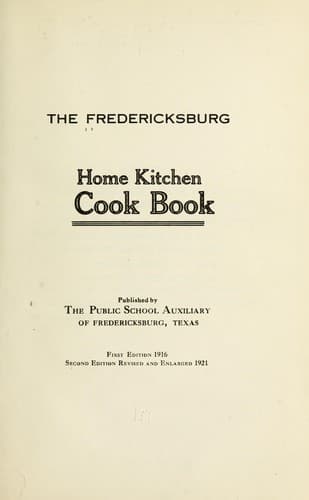
The Fredericksburg home kitchen cook book
192163 readable pages · 397 recipe records · general community household cookbook
From the librarian's dossier · AI-generated, grounded in the scanned text
The Fredericksburg Home Kitchen Cook Book is a 1921 community cookbook produced in Fredericksburg, Texas, a town founded by German immigrants along the Pedernales River. Published as a second edition tied to the town's 75th anniversary, the book opens with an unusual historical essay, 'Cooking and Culture on the Pedernales,' that frames home cooking as central to the community's identity from pioneer settlement through the railroad era. The bulk of the volume is a large, practical recipe collection spanning relishes, soups, fish and poultry, meats, vegetables, salads, puddings, pies, breads, cookies, cakes, sandwiches, candy, and preserves. Many recipes appear to be attributed to named contributors, suggesting the book was assembled from recipes submitted by local households, a common practice for fundraising or commemorative cookbooks of this era. The recipes mix mainstream American dishes of the period with German-influenced specialties such as Lebkuchen, Springerle, and Braut-Torte (Wedding Cake), reflecting the town's ethnic heritage. The book closes with pages of advertisements from local Fredericksburg merchants, offering a window into the commercial life of the town alongside the culinary content. For modern readers, this is both a practical historical recipe collection and a small artifact of German-American community life in central Texas in the early 1920s.
The book proceeds as a sequence of themed recipe sections rather than a strict alphabetical dictionary. It opens with front matter (officers, preface, and the historical introduction) in section 1, then moves through Relishes, Soups, Oysters and Fish, Poultry and Game, and Beef and Meat. Section 2 continues with starches, vegetables, and salads. Section 3 expands salads and dressings before moving into puddings and pies. Section 4 covers pie fillings, breads and yeast goods, and cookies, ending with early layer cakes. Section 5 is devoted almost entirely to cakes, frostings, fillings, baking hints, weights and measures, and sandwiches. Section 6 finishes sandwiches and candy, then covers jellies, preserves, and an extensive pickling chapter, closing with local advertisements. Section 7 consists mostly of further advertisements and a partial contents listing. The organization follows a typical course-based progression from savory to sweet, common in community cookbooks of this period.
Recipes from this book
397 records extracted from the text, showing the first 50 in reading order. Each links to a modern interpretation.
Read the book
63 readable pages. A dot marks pages with recipe records.