
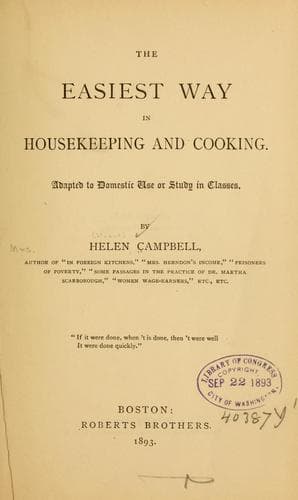
The easiest way in housekeeping and cooking
1881Helen Stuart Campbell · 146 readable pages · 263 recipe records · general household cookbook and domestic science manual
From the librarian's dossier · AI-generated, grounded in the scanned text
The Easiest Way in Housekeeping and Cooking is Helen Stuart Campbell's 1881 manual (later reissued in a revised edition) aimed at inexperienced homemakers and at teachers instructing students in domestic science. Rather than presenting a bare recipe collection, Campbell frames cooking within a larger program of household management, beginning with how to choose and arrange a healthy home before moving into fire and lamp care, laundry, cleaning, and only then into nutrition science and food preparation. The book blends practical recipes for soups, fish, meats, breads, cakes, puddings, preserves, and candies with physiological explanations of digestion and food composition, reflecting an era when cookbooks doubled as home economics primers. Later sections extend into invalid cookery, household cleaning formulas, weights and measures, cooking time tables, and even sample lesson plans and examination questions for teaching cooking as a school subject. The book closes with an extensive alphabetical index and publisher advertisements for Campbell's other works. Modern readers will find a text that is as much about domestic ideology, hygiene, and the moral organization of the household as it is about food, offering a window into how one author tried to systematize homemaking as a teachable discipline in late nineteenth-century America.
The book moves from general household science to specific cookery and back to reference material. It opens with chapters on choosing and arranging a healthy home, ventilation, and cleanliness (section 1), then covers fires, lighting, kitchen equipment, and laundry (section 3), followed by house-cleaning and an extended excursion into human physiology and nutrition science (sections 4 and 5). The recipe core begins with stocks, soups, and fish (section 7), continues through meats, poultry, sauces, eggs, and breakfast dishes (sections 8, 9, and 10), then vegetables and breads (section 11), cakes, pastry, and puddings (section 12), and desserts, preserving, pickling, and candy-making (section 13). The book closes with invalid cookery, cleaning formulas, measurement conversion tables, cooking time tables, sample lesson plans and examination questions for teaching cooking, and a detailed index followed by publisher advertisements (sections 14 and 15).
Recipes from this book
263 records extracted from the text, showing the first 50 in reading order. Each links to a modern interpretation.
Read the book
146 readable pages. A dot marks pages with recipe records.