
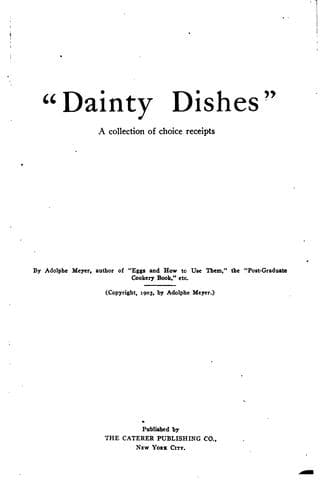
"Dainty dishes"
1903Adolphe Meyer · 40 readable pages · 186 recipe records · formal French-style culinary recipe collection
From the librarian's dossier · AI-generated, grounded in the scanned text
Dainty Dishes is a 1903 collection of refined recipes by Adolphe Meyer, presenting the elaborate hors d'oeuvre, entrees, and savory courses associated with formal French-influenced dining of the era. Across its four sections the book moves through cold and hot appetizers, shellfish and fish preparations, meat and poultry entrees, vegetable and egg dishes, and an extensive treatment of cheese preparations. Recipe titles are given in French with English translations, reflecting the fashion for French culinary terminology in high-end American and European kitchens of the period. The 186 anchored food records give a sense of the book's density and its focus almost entirely on food preparations rather than household matters. Readers will find recipes built around luxury ingredients such as foie gras, truffles, lobster, and game birds, alongside techniques like forcemeat preparation, aspic work, chaudfroid coating, and mortar-and-sieve processing. The book reads less like a home cookbook and more like a professional or aspirational reference for banquet and restaurant-style service, offering a window into the elaborate presentation standards prized in fine dining at the turn of the twentieth century.
The book is organized into four sections that progress through courses in the manner of a formal menu. Section 1 opens with cold hors d'oeuvre and savouries, moves to hot hors d'oeuvre, and then into fish and shellfish dishes. Section 2 continues with cold entrees using aspic and chaudfroid techniques, followed by miscellaneous entrees and dainty dishes featuring foie gras and croquettes. Section 3 covers vegetables and egg dishes alongside advanced meat, poultry, and game preparations such as cromesquis and sweetbreads. Section 4 closes with detailed egg dishes, including cold aspic preparations and hot souffles and croquettes, followed by an extensive cheese section covering fritters, straws, souffles, and rarebit variations.
Recipes from this book
186 records extracted from the text, showing the first 50 in reading order. Each links to a modern interpretation.
Read the book
40 readable pages. A dot marks pages with recipe records.