
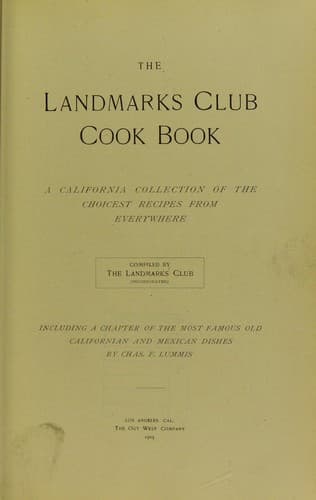
The Landmarks club cook book
1903The Landmarks club, Los Angeles, Calif. · 145 readable pages · 772 recipe records · general household cookbook with a regional Spanish-American and Latin American culinary supplement
From the librarian's dossier · AI-generated, grounded in the scanned text
The Landmarks Club Cook Book (1903) is a community-assembled American cookbook produced under the auspices of the Landmarks Club of Los Angeles, an organization dedicated to preserving California's Franciscan mission buildings. Its most distinctive feature, foregrounded by Charles F. Lummis in his introduction, is a substantial opening chapter of Spanish-American, Mexican, and Peruvian dishes, many said to be recorded in English for the first time. From there the book settles into the familiar architecture of a turn-of-the-century household cookbook, moving through soups, seafood, poultry, meats, salads, entrees, sauces, vegetables, eggs, cheese, puddings, pastries, frozen desserts, cakes, cookies, preserves, breads, beverages, confections, and a closing miscellany of menus and household hints. Recipes are frequently credited to named contributors, suggesting the book was compiled from a community of home cooks rather than written by a single author. The cuisine reflects an affluent, well-traveled Southern California household, drawing on French culinary technique and imported ingredients like truffles and Madeira alongside regional Californian and Latin American staples such as chiles, tamales, and tropical fruits. Modern readers will find it a rich artifact of early twentieth-century American foodways, regional identity, and charitable fundraising cookbook culture, as much a document of cultural preservation as a cooking manual.
The book opens with front matter, a foreword, and Lummis's introductory essay before launching into a dedicated chapter of Spanish-American, Mexican, and Peruvian recipes (section 1-2). It then follows a conventional numbered chapter sequence covering soups, fish and shellfish, poultry and game, meat-selection guidance and meat dishes, salads, entrees, sauces, vegetables, eggs, cheese, puddings, pastry and pies, frozen desserts and sauces, cakes and icings, cookies and small cakes, preserves and pickles, breads and rolls, beverages, confections, picnic foods, invalid cookery, and a final chapter of menus, household recipes, and reference tables including weights, measures, and an index (sections 3-15). The organization mirrors standard household cookbooks of the period, with named contributors credited throughout many sections, indicating a compiled, multi-author structure typical of club or charitable cookbooks.
Recipes from this book
772 records extracted from the text, showing the first 50 in reading order. Each links to a modern interpretation.
Read the book
145 readable pages. A dot marks pages with recipe records.