
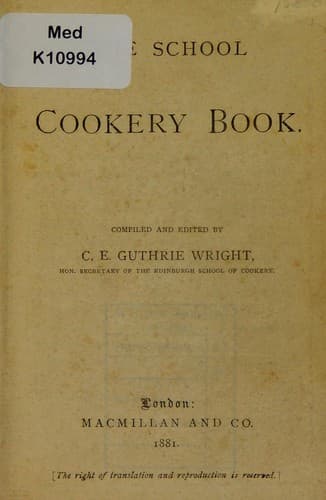
The school cookery book
188178 readable pages · 225 recipe records · school domestic science cookbook
From the librarian's dossier · AI-generated, grounded in the scanned text
The School Cookery Book (1881) is a British educational cookbook compiled by C.E. Guthrie Wright for the Edinburgh School of Cookery, designed to teach elementary school pupils the principles and practice of domestic cookery. It opens with a theoretical section on nutrition, explaining food classes and how diet should be adapted to age, health, climate, and occupation, before moving into an extensive practical section covering soups, fish, meat, poultry, vegetables, pastry, puddings, eggs, sauces, bread, beverages, and invalid and infant cookery. The recipes are frugal and technique-focused, reflecting a mission to train working and middle-class households in economical, nourishing cooking rather than elaborate cuisine. Throughout, the book pairs recipe instructions with explanations of method and reasoning, consistent with its classroom origins. It closes with practical guidance for setting up school cookery classes and a full index. Modern readers will find a window into Victorian domestic science education, household economy, and ideas about nutrition and health, alongside dishes ranging from haggis and Irish stew to milk puddings and invalid broths. The book is notable for its systematic, almost textbook structure, treating cookery as a teachable science with underlying nutritional principles rather than simply a list of recipes.
The book is organized in two main parts. Part I (section 1) is theoretical, covering nutrition, food classes, cooking principles, and dietary adaptation by age and health. Part II (sections 2 through 8) is practical, opening with dietary guidance for illness and kitchen basics such as weights, measures, and meat cuts (section 2), then proceeding through numbered chapters on soups, fish, and meat by cooking method: boiling, stewing, frying (sections 3 and 4), poultry, traditional dishes, vegetables, and the start of pastry (section 5), further pastry and puddings (section 6), eggs, sauces, bread, and beverages with invalid cookery (section 7), and finally invalid and infant feeding, poultices, appendix material on organizing school cookery classes, and an alphabetical index (section 8). The organization follows cooking methods and food categories rather than a strict menu sequence, mirroring a classroom curriculum.
Recipes from this book
225 records extracted from the text, showing the first 50 in reading order. Each links to a modern interpretation.
Read the book
78 readable pages. A dot marks pages with recipe records.