
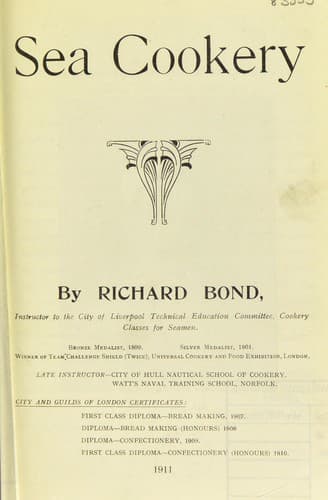
Sea Cookery
1911Richard Bond · 105 readable pages · 374 recipe records · general household cookbook adapted for maritime/shipboard use
From the librarian's dossier · AI-generated, grounded in the scanned text
Sea Cookery (1911) by Richard Bond is a technical manual written specifically for cooks working aboard ships, addressing the practical realities of preparing food in a shipboard galley with limited space, constrained stores, and rolling conditions at sea. Bond opens with endorsements from naval officials and supply firms, framing the book as a corrective to the poor historical reputation of ship's cooks. The bulk of the text is organized as a working recipe collection, moving through soups, fish, sauces, meats, poultry, vegetables, puddings, cold sweets, cakes, biscuits, breads, and savouries, totaling around 375 identifiable food records. Bond repeatedly grounds his instructions in the practicalities of shipboard provisioning, such as preserved and salt meats, egg preservation methods, flour storage, and the challenges of yeast fermentation at sea. The book blends scientific explanation of cooking processes, such as heat coagulation in boiling and yeast biology in bread-making, with an extensive, almost encyclopedic recipe collection drawn from British culinary tradition. Modern readers will find it a window into early twentieth-century maritime labor conditions and domestic-style cookery adapted for institutional and shipboard use, written with an economical, no-waste ethos suited to long voyages.
The book opens with introductory material (section 1) covering prefaces, endorsements, and practical hints on stores, ventilation, and preservation before the recipes begin. From there it proceeds through a long sequence of instructional and recipe sections: general techniques such as frying, boiling, and flavoring (section 2), yeast and dough science followed by soups (section 3), fish and sauces (sections 4 and 5), meat and poultry (sections 5 and 6), vegetables and hot puddings (section 7), cold sweets, ices, and baked goods (section 8), an extensive run of cakes, biscuits, buns, and bread techniques (sections 9 and 10), and finally a miscellany of pastes, pickles, preserves, invalid dishes, homemade baking powder, and branded preparations (section 11). The organization follows a course-based, dictionary-like progression typical of household cookbooks of the period, but is consistently inflected by shipboard concerns such as preserved meats, stores management, and galley equipment.
Recipes from this book
374 records extracted from the text, showing the first 50 in reading order. Each links to a modern interpretation.
Read the book
105 readable pages. A dot marks pages with recipe records.