
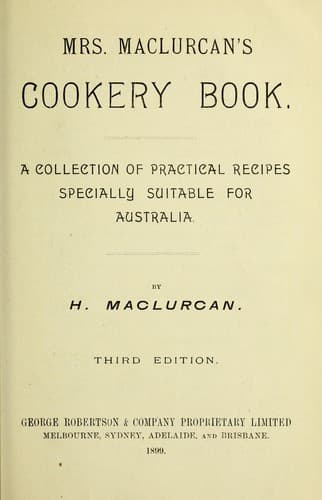
Mrs. Maclurcan's cookery book
1899H. Maclurcan · 150 readable pages · 747 recipe records · general household cookbook
From the librarian's dossier · AI-generated, grounded in the scanned text
Mrs. Maclurcan's Cookery Book is a substantial household cookery manual first published in colonial Australia, here represented in its third edition of 1899. Written for Australian kitchens, it moves from soups and stocks through fish, oysters, entrees of mutton, beef, veal, tripe and poultry, into game, savouries, pastry, puddings, jellies, ices, cakes, bread, sweets, preserves, eggs, breakfast dishes, beverages and elaborate dinner menus, before closing with household and toilet hints and a detailed index. It reflects a Queensland and North Australian domestic setting, with recipes for kangaroo tail soup, roast wallaby, wonga pigeon and tropical fruits like granadilla and passion fruit sitting alongside familiar British dishes such as Devonshire dumplings and Chandos pudding. The book also caters to inland or remote households through advice on tinned fish and camp oven baking. With over seven hundred anchored food recipes and only a single medicinal entry, this is overwhelmingly a cookery text rather than a domestic medical guide, though a few pages of household and beauty remedies appear near the end. It offers modern readers a vivid, practical window into colonial Australian foodways, entertaining customs, and everyday kitchen management at the close of the nineteenth century.
The book is organized as a sequence of thematic culinary sections, beginning with soups and stocks (section 1) and moving through fish and oysters (sections 2 and 3), then mutton, beef, veal, tripe, and poultry entrees (sections 3 and 5), sauces, salad dressings, and vegetables (section 7), game and savouries (sections 8 and 9), pastry, pies, and puddings (sections 9 and 11), jellies, creams, ices, and cakes (sections 11 and 12), bread (section 12), sweets, chutneys, pickles, and preserves (section 13), and finally eggs, breakfast dishes, beverages, and large-scale dinner menus (section 14). The book closes with household and toilet hints, followed by a categorized index and advertisements (section 15). Recipes throughout are numbered and grouped under bold category headings, with the later sections increasingly geared toward entertaining and household management rather than single dishes.
Recipes from this book
744 records extracted from the text, showing the first 50 in reading order. Each links to a modern interpretation.
Read the book
150 readable pages. A dot marks pages with recipe records.