
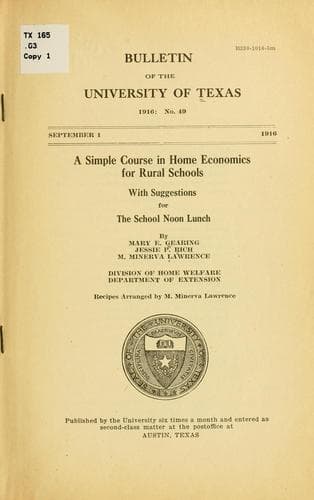
A simple course in home economics for rural schools
1916Mary Edna Gearing · 63 readable pages · 123 recipe records · rural home economics curriculum and cookbook
From the librarian's dossier · AI-generated, grounded in the scanned text
This 1916 bulletin by Mary Edna Gearing presents a structured home economics curriculum designed specifically for rural one- and two-room schoolhouses that lacked formal domestic science facilities. Rather than a conventional cookbook for a home kitchen, it is a teaching manual that combines recipes with lesson plans, budgets for minimal equipment, and cross-curricular connections to arithmetic, geography, nature study, and English. The book moves through foundational food groups and techniques, from beverages and candy to canning, cereals, cheese, corn, eggs, fruits, potatoes, legumes, meat, milk, quick breads, soups, vegetables, and yeast bread. Interwoven with practical recipes are discussions of nutrition science, food composition, and cultural or historical anecdotes such as apple legends and international bread-making traditions. The noon lunch program and picnic cooking sections show an effort to make the material useful for both classroom instruction and everyday rural family life. For modern readers, the book offers a window into early twentieth-century efforts to bring scientific home economics education to underserved rural communities, revealing period assumptions about nutrition, thrift, gender roles in domestic education, and the practical challenges of teaching cooking with very limited equipment and budgets. It is as much an educational curriculum guide as it is a recipe collection.
The book is organized as a sequential teaching curriculum rather than a conventional recipe compendium. It opens with practical guidance on equipping a rural school kitchen on a small budget and a proposed noon lunch program (section 1), then proceeds topic by topic through candy-making and canning basics (section 2), eggs and fruit science alongside frozen desserts (section 3), potatoes, legumes, meat, and milk (section 4), peanuts, quick breads, rice, and salads with meal-planning instruction (section 5), soups, picnic cookery, table service, vegetables, and the fundamentals of yeast bread (section 6), and finally a detailed bread and roll baking unit (section 7). Each topical unit typically combines subject matter explanation, lesson plans with stated teacher and pupil aims, related-subjects cross-references, discussion questions, and recipes, reflecting its purpose as an instructional bulletin for teachers as much as a source of dishes to prepare.
Recipes from this book
123 records extracted from the text, showing the first 50 in reading order. Each links to a modern interpretation.
Read the book
63 readable pages. A dot marks pages with recipe records.