
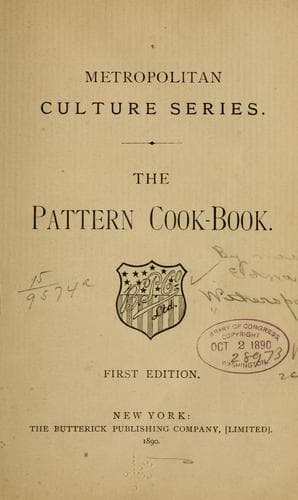
The Pattern cook-book
1890Butterick Publishing Company · 269 readable pages · 715 recipe records · general household cookbook
From the librarian's dossier · AI-generated, grounded in the scanned text
The Pattern Cook-Book (1890), issued by the Butterick Publishing Company, is a comprehensive household cookery manual aimed at both novice and experienced cooks. It opens with a prefatory discussion of the history of cookery and the science of food and nutrition, then moves through kitchen management, meat and poultry cookery, fish and shellfish, vegetables, breads, desserts, and beverages. With 715 anchored food records and only a handful of household and medicinal entries, the book is overwhelmingly a working culinary reference, though it also brushes against domestic advice such as kitchen design, beauty and foot care, and invalid cookery. Its recipes reflect the ingredients, equipment, and economic concerns of an American household kitchen at the close of the nineteenth century, including thrift-minded uses of leftovers, home curing of meats, and elaborate dessert and confectionery work. Modern readers will find both highly technical instructions (puff-paste, custards, sugar-boiling stages) and now-unfamiliar cuts and preparations (calf's head cheese, scrapple, terrapin). The book's scope, moving from scientific rationale to exhaustive recipe listings and closing with an alphabetical index, marks it as a serious reference work for running a Victorian-era kitchen rather than a slim recipe pamphlet.
The book proceeds from general principles to specific recipes. It opens with prefatory material on the history and science of cooking and kitchen design (section 1), followed by kitchen equipment and marketing guidance (section 2). The bulk of the text is organized by ingredient category in a roughly logical cooking sequence: meat techniques and soups (sections 3-4), fish and shellfish (sections 5-6), beef, veal, variety meats, mutton, lamb and pork (sections 6-9), poultry and game (sections 9-11), vegetables and salads (sections 11-14), cheese and eggs (sections 14-15), breads and breakfast items (sections 15-17), pastry and pies (sections 17-18), puddings, frozen desserts, and custards (sections 18-22), cakes and confectionery (sections 22-24), and beverages, invalid cookery, and reference material (sections 25-27). The book concludes with fundamental kitchen techniques (sugar boiling, flavored sugars, preserving) and an alphabetical index (section 27). Section numbering in the summaries skips from 25 to 27, suggesting a section 26 was not captured or gated separately.
Recipes from this book
712 records extracted from the text, showing the first 50 in reading order. Each links to a modern interpretation.
Read the book
269 readable pages. A dot marks pages with recipe records.