
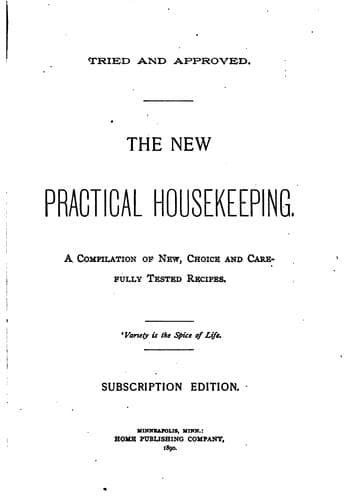
The new practical housekeeping
1890Estelle Woods Wilcox · 602 readable pages · 1,491 recipe records · alphabetical household cookbook and domestic reference manual
From the librarian's dossier · AI-generated, grounded in the scanned text
The New Practical Housekeeping (1890) by Estelle Woods Wilcox is a sprawling American household manual built around more than 1,400 anchored food entries, organized alphabetically by topic in the manner of a culinary reference work rather than a narrative cookbook. Presented as a companion volume to an earlier Practical Housekeeping, it opens with the chemistry of bread and flour before moving through an enormous range of subjects: cakes, pastries, canning and preserving, sauces and catsups, eggs, fish and shellfish, game, ices and ice cream, meats, poultry, puddings, salads, soups, vegetables, pickles, and beverages. Beyond recipes, it addresses kitchen science, household management, table service, carving, dietary advice, and even flower gardening, positioning cookery as one part of a broader domestic competence expected of the Victorian-era housekeeper. The book combines detailed technical instruction, such as testing oven heat with paper or judging sugar syrup stages by hand, with an evident concern for economy, nutrition, and elegant presentation. Modern readers will find both a practical record of period kitchen technique and a window into the values, tastes, and domestic expectations of late nineteenth-century American households. Its scale and alphabetical structure make it better suited to browsing or reference use than cover-to-cover reading.
The book is organized as a long alphabetical sequence of culinary and household topics, moving from bread and yeast through cakes, canning, catsups and sauces, cheese, confectionery, creams and custards, coffee and tea, eggs, fish, fritters and croquettes, fruit, game, griddle cakes, ices, jams and jellies, meats (organized by animal and cut), mush and mushrooms, pastry and pies, pickles, potatoes, poultry, preserves, puddings, salads, shellfish, soups, vegetables, and vinegar, before closing with dining-room notes, garnishes, a French culinary glossary, carving instructions, dietary hints, flower gardening, infant feeding guidance, miscellaneous household tips, and a full alphabetical recipe index (section 60). Each major subject is typically introduced with general principles or science before listing numerous specific recipes, a pattern repeated across sections 1 through 58.
Recipes from this book
1,491 records extracted from the text, showing the first 50 in reading order. Each links to a modern interpretation.
Read the book
602 readable pages. A dot marks pages with recipe records.