
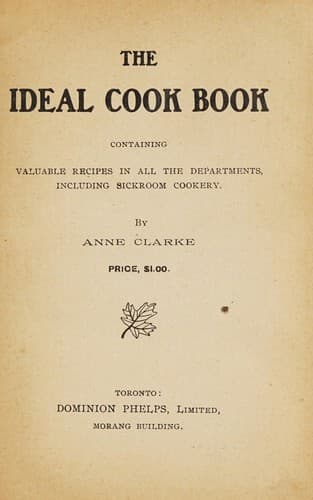
The Ideal cook book
1899Anne Clarke · 176 readable pages · 782 recipe records · general household cookbook with domestic medical guide
From the librarian's dossier · AI-generated, grounded in the scanned text
The Ideal Cook Book (1899) by Anne Clarke is a late-Victorian household manual combining an extensive general cookbook with sections on invalid cookery and home medical treatment. Beginning with a preface on the importance of cookery for families of all social classes, it moves through soups, fish, poultry, game, and meats before covering vegetables, salads, pickles, eggs, condiments, breads, cakes, puddings, pies, pastries, desserts, preserves, and butter-making. The book closes with sections on invalid cookery, sick-room drinks, and a lengthy domestic medical guide addressing fevers, fractures, childhood diseases, and common ailments. With 782 anchored food records alongside a small number of household and medicinal entries, the volume reflects the period's blending of culinary and health guidance within a single household reference. Its scope, from Scotch Crowdie to Charlotte Russe to beef tea for the sick, illustrates the breadth expected of a comprehensive cookbook of its era. Modern readers will find both an artifact of Victorian domestic economy and a window into how cookery and home medicine were once inseparable concerns for the household manager, presented with period techniques, measures, and remedies that require careful, historically-minded reading today.
The book proceeds through a logical sequence of culinary categories: introductory observations on cooking methods (section 1), followed by soups and fish (sections 1-2), poultry, game, and meats (sections 3-4), vegetables, salads, pickles, and eggs (sections 6-8), forcemeats and bread/cake observations (section 8), breads and cakes (sections 8-10), puddings and pastry (sections 10-12), pies and fritters (section 12), desserts, sweet dishes, and ice creams (section 13), preserves, jellies, and butter-making (section 14), fancy butters, cheese dishes, and invalid cookery (section 15), and finally sick-room drinks and an extensive domestic medical guide called 'The Doctor' (sections 16-18), ending with an index. Numbered recipe entries run throughout (e.g., recipes 530-596, 937-955, 1014-1019), suggesting a continuously numbered reference system across the whole volume rather than separate books.
Recipes from this book
781 records extracted from the text, showing the first 50 in reading order. Each links to a modern interpretation.
Read the book
176 readable pages. A dot marks pages with recipe records.