
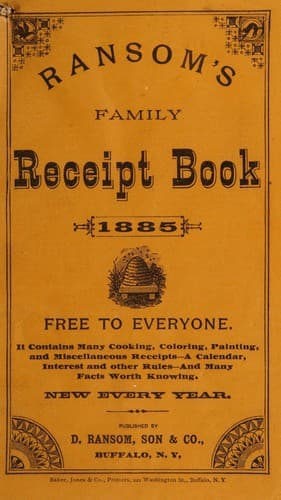
Ransom's family receipt book, 1885
1885D. Ransom, Son & Co · 33 readable pages · 82 recipe records · general household cookbook with patent medicine advertising
From the librarian's dossier · AI-generated, grounded in the scanned text
Ransom's Family Receipt Book of 1885 is a hybrid volume typical of nineteenth-century promotional publishing: part household cookbook, part patent medicine catalog. Issued by D. Ransom, Son & Co, it interleaves genuine domestic recipes, tested by household contributors, with extensive advertising for the company's proprietary remedies, most prominently Dr. Trask's Magnetic Ointment and King of the Blood. Readers will find soups, meat dishes, sauces, puddings, breads, cakes, preserves, and pickles alongside invalid cookery meant for the sick, and then, without much separation, testimonials from physicians and cured patients praising the manufacturer's tonics and balms. The book also drifts into practical household and farm matters, offering guidance on measuring land, weighing cattle, painting, and dyeing fabric at home. Modern readers should approach this as a period artifact of commercial cookbook publishing, where recipe content served partly as a vehicle to build trust in a medicine business. The mixture of cookery, home remedies, and advertising rhetoric offers a window into how domestic authority and commercial persuasion were intertwined in household print culture of the era. It is best read as both a cooking reference and a marketing document.
The book is organized into four sections that blend cookery, invalid food preparations, medicine advertising, and household reference material rather than following a single clean division. Section 1 opens with soups, meat dishes, sauces, and desserts interspersed with promotional material for Ransom medicines. Section 2 continues with puddings, yeast and bread recipes, cakes, preserves and pickles, and invalid cookery, again interrupted by advertisements and testimonials. Section 3 shifts toward invalid and convalescent cookery plus household and farming reference information (land measurement, grain estimation, cattle weighing) and dyeing instructions, continuing the medicine promotions. Section 4 closes the book with detailed textile dyeing recipes for wool and cotton, preceded by another medicinal testimonial, and ends near a calendar reference for 1885.
Recipes from this book
82 records extracted from the text, showing the first 50 in reading order. Each links to a modern interpretation.
Read the book
33 readable pages. A dot marks pages with recipe records.