
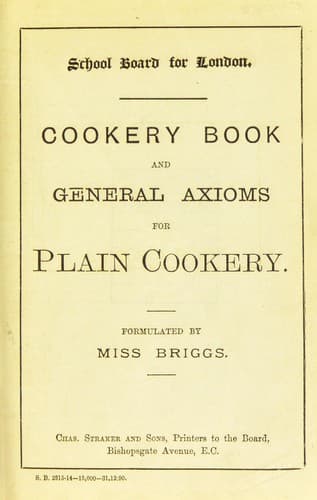
Cookery book and general axioms for plain cookery
1890E. Briggs · 51 readable pages · 153 recipe records · instructional household cookbook / cookery school textbook
From the librarian's dossier · AI-generated, grounded in the scanned text
This is a practical teaching cookbook compiled by E. Briggs in 1890, built around a course of instruction created for the London School Board. Rather than a simple recipe collection, it presents cookery as a subject to be taught methodically, with graduated lessons, demonstration, hands-on student practice, and assessment through questions. The book moves through everyday dishes such as soups, egg preparations, pies, puddings, breads, and roasted or boiled meats, alongside a distinct category of invalid cookery, including beef tea, gruel, arrowroot, and steamed fish, reflecting the era's attention to food for the sick and convalescent. Recipes are paired with numbered explanatory notes that justify technique and offer economy tips, culminating in a formal set of 28 axioms distilling general principles of plain cookery. An index closes the volume. Modern readers will find a window into working and lower-middle-class British domestic training of the period, where cooking was taught as applied science and thrift, not instinct. The tone is instructional and systematic throughout, closer to a classroom manual than a leisure cookbook, making it useful both as a historical culinary record and as a document of Victorian educational practice in domestic subjects.
The book is organized as a graduated teaching course rather than a conventional alphabetical recipe collection. Section 1 opens with the preface, contents, and an explanation of the School Board program and teaching plan, followed by a twenty-lesson syllabus moving from simple soups and eggs to meats, fish, pies, and breads. Sections 2 through 4 present recipes grouped by dish type, pastries, puddings, invalid foods, meats, vegetables, and preserves, interspersed with numbered technical notes explaining methods. Section 3 introduces a second twenty-lesson syllabus with axiom references, showing the course repeating its instructional structure at a more advanced level. Section 5 closes the book with further recipes, then a formal list of 28 numbered axioms summarizing cooking principles, supporting notes citing authorities such as Soyer, and a concluding recipe index.
Recipes from this book
153 records extracted from the text, showing the first 50 in reading order. Each links to a modern interpretation.
Read the book
51 readable pages. A dot marks pages with recipe records.