
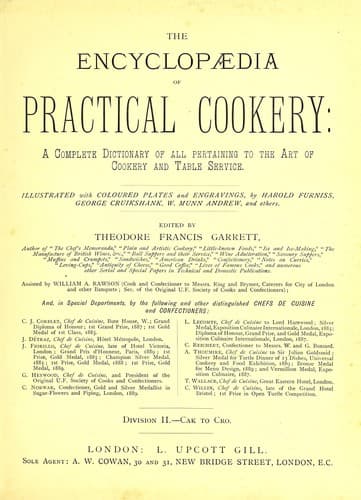
The encyclopædia of practical cookery
1890Theodore Francis Garrett · 581 readable pages · 1,476 recipe records · alphabetical culinary encyclopedia
From the librarian's dossier · AI-generated, grounded in the scanned text
The Encyclopaedia of Practical Cookery by Theodore Francis Garrett (1890) is a monumental Victorian culinary reference organized as an alphabetical dictionary rather than a conventional menu-based cookbook. Spanning topics from cakes and calf's offal to champagne, cheese, chocolate, coffee, and crayfish, it reflects the encyclopedic ambitions of late nineteenth-century British cookery writing. The surviving sections trace an alphabetical arc through the letters C, with occasional earlier material on cakes, revealing a work of enormous scope that treats food alongside related subjects such as wine, liqueurs, kitchen equipment, carving instruction, and even folk remedies. Recipes are addressed to a well-equipped household or professional kitchen, drawing heavily on French classical technique, elaborate garnishes, and ingredients like truffles, isinglass, and forcemeat that signal upper-middle-class or professional dining. The book mixes rigorous technical instruction (sugar-boiling temperatures, gelatine work, freezing methods) with historical and botanical digressions on ingredients like carrots, cinnamon, and cardoons. For the modern reader, it offers a vivid window into Victorian culinary ambition, combining scientific pretensions with ornate presentation. It is best approached not as a book to cook through in sequence, but as a reference to browse, entry by entry, kind of the way one might explore an old-fashioned dictionary.
The book is arranged as a single continuous alphabetical dictionary of culinary subjects, moving from entries under 'C' (calf, capers, capons, cauliflower, celery, champagne, cheese, cherries, chestnuts, chocolate, Christmas fare, cinnamon, citron, clams, cocoa, coconuts, cod, coffee, consomme, cordials, cornflour, crab, crayfish, cream) interspersed with a long run of cake recipes early in the surviving material. Each alphabetical headword typically opens with etymology, botanical or historical background, and technique notes, followed by numbered recipe variations. Section headings repeatedly direct readers to other parts of the book for related culinary processes, utensils, and sauces, confirming the work's function as a cross-referenced reference text rather than a linear narrative. Some sections (2, 33, 39, 46, 51, 53, 55) are absent from the supplied summaries, suggesting gaps in the mechanically gated material rather than an absence of content in the original book.
Recipes from this book
1,476 records extracted from the text, showing the first 50 in reading order. Each links to a modern interpretation.
Read the book
581 readable pages. A dot marks pages with recipe records.