
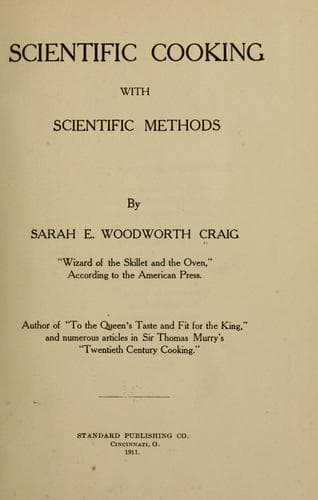
Scientific cooking with scientific methods
1911Sarah E. Woodworth Craig · 177 readable pages · 742 recipe records · general household cookbook with domestic science framing
From the librarian's dossier · AI-generated, grounded in the scanned text
Published in 1911, Scientific Cooking with Scientific Methods by Sarah E. Woodworth Craig belongs to the era of American cookbooks that sought to marry kitchen practice with the emerging authority of domestic science. The book opens with an editor's note praising Craig's background and her embrace of gas stove technology, then lays out a scientific framework: the chemical elements of the human body, classification of foods into proteids, carbohydrates, fats, and minerals, and guidance on diet suited to age, occupation, and climate. From there it proceeds through the full architecture of a household cookbook, covering breads, soups, fish and shellfish, meats, poultry and game, vegetables, sauces, entrees, desserts, frozen dishes, beverages, salads, cakes, confections, chafing-dish cookery, invalid and children's foods, preserving, and household reference material. With 742 anchored food records, it is a dense and wide-ranging text aimed at the modern (for its time) housekeeper seeking both nutritional rationale and detailed recipes. The book closes with tables of weights and measures, cooking times, French culinary terms, and menus, alongside a full alphabetical index and period advertisements. It stands as a document of how scientific and domestic ideals were fused in early twentieth-century American kitchen literature.
The book is organized into numbered chapters that move from scientific preliminaries (food chemistry, nutrition, diet by age and climate) into a long sequence of practical cookery chapters: breads and cereals, soups, fish, shellfish, beef, veal, lamb and mutton, sweetbreads and pork, poultry and game, sauces, vegetables, entrees (croquettes, timbales, fritters, aspics), pastry and hot puddings, frozen desserts, tea and coffee, cocoa and chocolate, salads, canapes and sandwiches, cakes, frostings and candies, chafing-dish cookery, invalid and children's foods, fruit preservation, pickling, and finally household reference material (weights and measures, cooking time tables, French terms, and menus). The volume ends with a comprehensive alphabetical index and period advertisements.
Recipes from this book
741 records extracted from the text, showing the first 50 in reading order. Each links to a modern interpretation.
Read the book
177 readable pages. A dot marks pages with recipe records.