
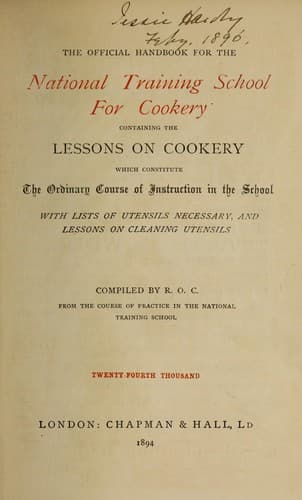
The official handbook for the National Training School for Cookery
1891National Training School for Cookery (London) · 182 readable pages · 293 recipe records · professional cookery training manual
From the librarian's dossier · AI-generated, grounded in the scanned text
This 1891 volume is the official handbook of the National Training School for Cookery in South Kensington, London, an institution that trained both home cooks and professional cookery teachers. Rather than a casual recipe collection, it presents itself as a 'grammar of cookery,' teaching systematic method through numbered lessons with exact quantities, costs, and timings instead of vague traditional instructions. The book moves methodically through the core disciplines of a Victorian kitchen: roasting, boiling, baking, and frying meat; economical reuse of cooked and tinned meats; soup-making; fish cookery; vegetables and sauces; pastry; puddings, jellies, and creams; cakes and breads; and a substantial section on invalid or sick-room cookery. It closes with the school's own course schedules, fees, and admission rules, situating the recipes within a formal teaching program rather than a domestic manuscript. Readers will find over 290 anchored food entries, ranging from Mulligatawny Soup and Braised Fillets of Beef to Charlotte Russe and Barley Water. The tone throughout is practical and pedagogical, aimed at building competence through repetition, precise costing in shillings and pence, and attention to fire and oven management. It offers a detailed window into how professional cookery was standardized and taught in late Victorian England, blending kitchen economy with aspirations to refined, health-conscious, and disciplined culinary training.
The handbook is organized as a sequence of numbered lessons grouped by technique and course type rather than a simple alphabetical recipe list. It opens with preface material, philosophy of instruction, and utensil and cleaning-material lists (section 1), then proceeds through meat cookery in stages: roasting and boiling basics, frying and reuse of cooked meat, Australian tinned meat dishes, and progressively more elaborate entrees, offal, and pastry-wrapped meat dishes (sections 1 through 7). Soup lessons follow (sections 8 to 9), then fish cookery (sections 9 to 10), vegetables and sauces (sections 10 to 11), pastry fundamentals (section 11), and an extended run of puddings, jellies, creams, and souffles (sections 12 to 15). Cakes, buns, biscuits, and bread-making occupy section 16, followed by invalid and sick-room cookery, beverages, and appendix recipes (section 17). The book concludes with the school's actual weekly course menus, fee structures, and admission rules (section 18), an alphabetical index, and period advertisements for cookery books and kitchen equipment (section 19).
Recipes from this book
293 records extracted from the text, showing the first 50 in reading order. Each links to a modern interpretation.
Read the book
182 readable pages. A dot marks pages with recipe records.