
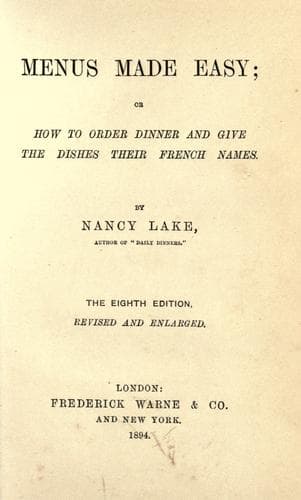
Menus made easy, or, How to order dinner and give the dishes their French names
1894Nancy Lake · 85 readable pages · 0 recipe records · French culinary dictionary and menu-planning guide
From the librarian's dossier · AI-generated, grounded in the scanned text
Menus Made Easy (1894) by Nancy Lake is a reference work for Victorian household mistresses who needed to order dinner in the fashionable French idiom without necessarily cooking the dishes themselves. Rather than a conventional recipe collection, it functions as a culinary dictionary and menu-planning guide, cataloging hundreds of French dish names alongside brief descriptions of their preparation, sauces, and garnishes. The book moves systematically through the courses of a formal dinner: hors d'oeuvres, soups, fish, entrees of meat and poultry, game, vegetables, salads, eggs, pastries, puddings, creams, ices, and sauces, closing with an alphabetical sauce and garnish reference and a full index. Lake's stated purpose, laid out in her introduction, is practical and social: to equip a household manager with the correct French terminology and an understanding of menu balance (light versus dark dishes, varied sauces, tasteful interspersing of cold courses) rather than to teach cooking technique from scratch. As such it offers modern readers a window into the elaborate, French-influenced dining culture of the late nineteenth-century English upper and upper-middle class household, where ordering dinner correctly was itself a marker of social competence.
The book is organized as a sequence of chapters following the logical order of a formal French-style dinner, beginning with an introduction and preface, then moving through hors d'oeuvres, soups, fish (organized by species), shellfish, beef, veal, mutton, lamb, pork, poultry, game and game birds, vegetables, salads, eggs and omelettes, pastries and cakes, puddings, fritters, fruit compotes, creams, jellies, souffles, cheese and savory dishes, ices and sorbets, and finally an alphabetical reference of sauces and garnishes followed by a comprehensive index. Within each chapter, dishes are grouped by ingredient or course type, with each entry giving a French name and a short account of preparation, sauce, and garnish.
Read the book
85 readable pages. A dot marks pages with recipe records.