
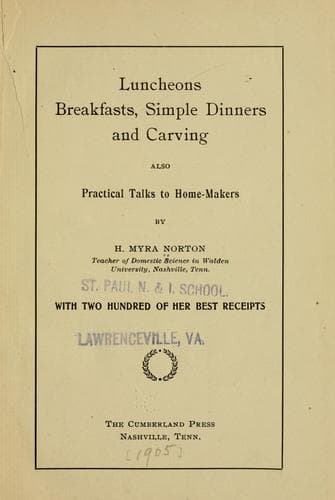
Luncheons, breakfasts, simple dinners and carving
1905H. Myra Norton · 43 readable pages · 122 recipe records · general household cookbook with etiquette guide
From the librarian's dossier · AI-generated, grounded in the scanned text
Published in 1905, this cookbook by H. Myra Norton combines practical culinary instruction with etiquette guidance and domestic advice, written explicitly for African American households. The book opens with foundational material on measuring, carving, and organizing meals before moving into a substantial recipe collection covering soups, meats, breads, pastries, cakes, puddings, and preserves. Beyond the kitchen, Norton devotes significant space to etiquette, addressing conduct in public, at church, in schools, and within family life, along with extended advice to mothers, fathers, girls, and boys on character and social behavior. The closing pages turn editorial, with Norton articulating her belief in domestic science as both art and profession, and expressing her ambition to become for African American cookery what a well known contemporary authority was for white cookery. The volume closes with references to Nashville educational institutions and advertisements. This is a book that blends the practical and the aspirational, positioning cooking and household management as tools of dignity, economy, and social advancement. Modern readers will find it a window into both the culinary practices and the social instruction offered to African American families in the early twentieth century, reflecting the author's dual commitment to feeding families well and preparing them for respectable social life.
The book moves from practical kitchen fundamentals (measuring, carving, meal planning) through an extensive recipe section organized by category (soups, meats, breads, pastries, cakes, puddings, sauces, preserves, candies), then pivots into household management and an extensive etiquette guide covering public conduct, church, school, home life, and advice tailored to mothers, fathers, girls, and boys. It concludes with an editorial essay on domestic science and manners, followed by material on Nashville educational institutions and advertisements.
Recipes from this book
122 records extracted from the text, showing the first 50 in reading order. Each links to a modern interpretation.
Read the book
43 readable pages. A dot marks pages with recipe records.