
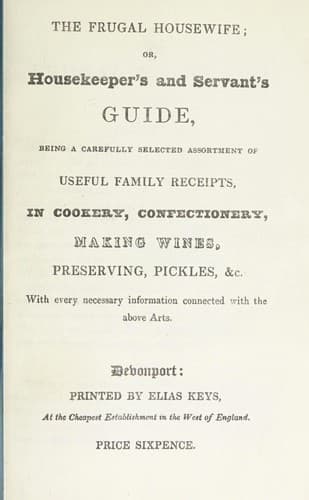
The frugal housewife, or, Housekeeper's and servant's guide, being a carefully selected assortment of useful family receipts, in cookery, confectionery, making wines, preserving, pickles, &c., with every necessary information connected with the above arts
190016 readable pages · 89 recipe records · general household cookbook
From the librarian's dossier · AI-generated, grounded in the scanned text
This is a 1900 edition of *The Frugal Housewife, or, Housekeeper's and Servant's Guide*, a practical manual for running an English-style household kitchen. Despite its late publication date, it belongs to a much older tradition of domestic receipt books, offering instructions across the full range of household food production: boiling and roasting meat, fish, and poultry; making pastries, custards, and confections; preserving fruit; baking cakes; pickling vegetables; and brewing home wines and beers. The book is organized as a dense sequence of short, instructional entries rather than a narrative, aimed at cooks and servants who needed clear, repeatable procedures for everyday and special-occasion cookery. Alongside food recipes, a small number of medicinal preparations appear, reflecting the era's blurred line between kitchen and home remedy. Modern readers will find a window into turn-of-the-century household management, with an emphasis on thrift, preservation, and self-sufficiency, as suggested by the title itself. The text assumes practical kitchen knowledge and gives measurements, timings, and techniques in the terse, direct style typical of household guides of this kind, making it a useful primary source for understanding domestic life and cooking practice of the period.
The book is organized into two mechanically identified sections spanning roughly 15 pages of anchored content. Section 1 opens the volume with meat, fish, and poultry cookery (boiling and roasting techniques with times), followed by pastries, custards, jellies, confections, and fruit preserving. Section 2 continues into more preserve-making (jams, jellies, fruit cheeses), moves into baking (pound cake, sponge cake, macaroons, rusks), then covers pickling (cucumbers, onions, walnuts, cabbage, nasturtiums) and finishes with home-brewed beverages (wines, ginger beer, spruce beer, soda water) and a few medicinal powders. The organization follows a traditional receipt-book arrangement by task or dish category rather than by meal or course, consistent with the book's stated purpose as a guide to cookery, confectionery, wine-making, preserving, and pickling.
Recipes from this book
89 records extracted from the text, showing the first 50 in reading order. Each links to a modern interpretation.
Read the book
16 readable pages. A dot marks pages with recipe records.