
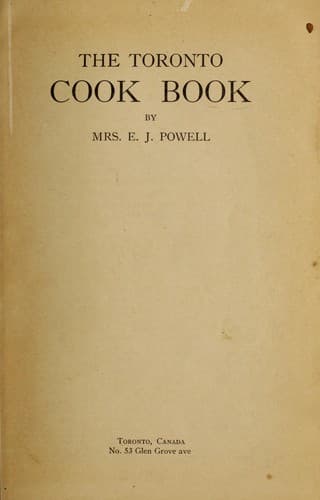
The Toronto Cook Book
1915Powell, E. J. Mrs.,d.b. 1853 · 186 readable pages · 1,308 recipe records · general household cookbook
From the librarian's dossier · AI-generated, grounded in the scanned text
The Toronto Cook Book (1915) by Mrs. E.J. Powell is a large household cookery manual from early twentieth-century Canada, compiled with contributions from figures like Mrs. H. C. Tomlin and support from the E.W. Gillett Company. It opens with an introductory essay grounding cookery in nutritional science, discussing water, proteids, fats, carbohydrates, and mineral salts, and advocating household efficiency. The bulk of the book is a sprawling recipe collection spanning breads, rolls, breakfast cakes, cookies, eggs, sandwiches, cheese dishes, beverages, frozen desserts, cakes, pies, puddings, salads, soups, seafood, fritters, croquettes, fish, vegetables, meats and poultry, preserves, pickles, and relishes. It closes with a brief section of home remedies and skincare recipes. The recipes range from simple family fare like breakfast rolls and boiled dinners to elaborate French-influenced dishes and formal dinner-party preparations such as Mortimer Salad and Faisans Rotis. Throughout, the text reflects a household economy sensibility, offering both simple and lavish versions of dishes, and reveals period assumptions about nutrition, domestic labor, and proper technique. For modern readers, it stands as both a practical historical recipe archive and a window into affluent Canadian domestic life of the 1910s, blending scientific-minded introduction with traditional and international culinary influences.
The book proceeds through broad food categories in a fairly standard early twentieth-century cookbook sequence: an introductory essay on nutrition and household efficiency, followed by breads and yeast goods, breakfast and tea cakes, doughnuts and cookies, eggs and sandwiches, beverages, frozen and jellied desserts, cakes and frostings, pies, puddings and sauces, salads and dressings, soups and broths, fish and shellfish chowders, fritters and croquettes, vegetables, an extensive run of meat and poultry preparations, preserving and canning, pickles and relishes, and finally a short closing section of home remedies and skincare recipes. Sections group recipes by dish type with occasional named contributors (such as an Astor House chef) and international or French-titled dishes interspersed among everyday fare. Headings within sections often repeat or shift subtly, suggesting the book was compiled in stages or from multiple contributed sources.
Recipes from this book
1,308 records extracted from the text, showing the first 50 in reading order. Each links to a modern interpretation.
Read the book
186 readable pages. A dot marks pages with recipe records.