
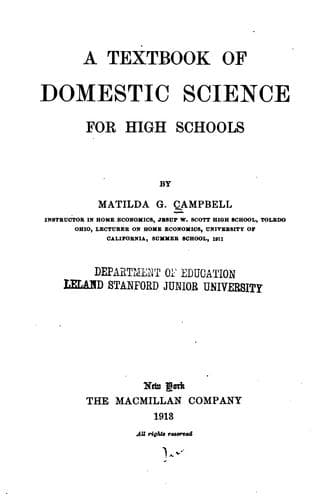
A textbook of domestic science for high schools
1913Matilda G. Campbell · 96 readable pages · 261 recipe records · domestic science textbook
From the librarian's dossier · AI-generated, grounded in the scanned text
Published in 1913 by Matilda G. Campbell, this is a domestic science textbook written for high school students rather than a conventional cookbook for the home kitchen. It blends chemistry, physiology, and practical cookery, teaching students the elemental composition of the human body and of food before moving into starches, sugars, proteins, fats, meats, breads, and desserts. Throughout, recipes serve as illustrations of scientific principles as much as instructions for eating, supported by prescribed classroom experiments, composition tables, and identification tests (for starch, dextrin, protein, and sugar, for example). The book also addresses household management topics such as water purification, beverages, invalid diets, and table service, reflecting its intended use as a comprehensive course of study in home economics. Modern readers will find a systematic, almost scientific approach to cooking that treats the kitchen as a laboratory for applied chemistry and nutrition. The text moves from theory to practice within each chapter, pairing explanations of chemical or physical processes with hands-on recipes and experiments. It offers a window into how domestic science was formally taught to young women in early twentieth-century American schools, and into the era's confidence that scientific method could improve household cookery, nutrition, and family health.
The book is organized into roughly twenty numbered chapters distributed across 9 mechanically gated sections. It follows a logical scientific progression: foundational chemistry and physics of food (section 1), carbohydrates and vegetables (section 2), sugars and fruit preservation moving into soups (section 3), proteins, eggs, and meats (section 4), continued meat cookery, poultry, fish, and dairy (section 5), water, beverages, and leavening chemistry (section 6), bread, fats, and pastry (section 7), cakes, puddings, mineral nutrition, and frozen desserts (section 8), and finally invalid diets and table service (section 9). Each section typically pairs scientific explanation with experiments and then practical recipes, building from principle to application.
Recipes from this book
261 records extracted from the text, showing the first 50 in reading order. Each links to a modern interpretation.
Read the book
96 readable pages. A dot marks pages with recipe records.