
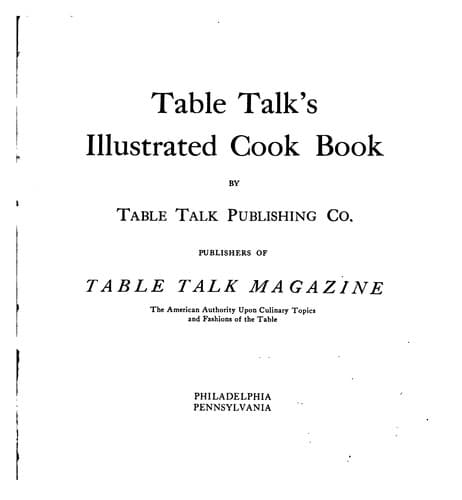
Table Talk's illustrated cook book
1906Table Talk Publishing Co. · 40 readable pages · 112 recipe records · general household cookbook
From the librarian's dossier · AI-generated, grounded in the scanned text
Table Talk's Illustrated Cook Book (1906) is a lavishly illustrated American cookbook produced by Table Talk Publishing Co., aimed at readers who entertained formally at home and cared as much about presentation as about flavor. Its pages move from dining room decor and table settings through punches, soups, fish, shellfish, meats, poultry, vegetables, salads, dressings, and an extensive run of molded desserts, puddings, frozen confections, and elaborate cakes, closing with wedding cake and cake-decorating instruction. Photographs and illustrations of dining rooms, table arrangements, molds, and decorating tools accompany the roughly 112 anchored recipes, reflecting a period fascination with visual display at the table, from bridesmaid luncheons to Christmas arrangements. The book is less a bare list of recipes than a guide to hosting: it teaches how to shape, mold, garnish, and serve food for specific social occasions, including graduations, weddings, and children's parties. Readers today will find it a window into turn-of-the-century American middle- and upper-class domestic entertaining, with particular emphasis on formal courses, decorative technique, and the era's fondness for punch bowls, aspics, molded creams, and fancy cakes. It rewards browsing for its combination of practical cookery and social choreography rather than sequential reading.
The book is organized in four broad movements. Section 1 opens with dining room and table decoration guidance before moving into beverages (punches, coffee, chocolate) and a long run of soups, ending with early fish recipes. Section 2 continues with shellfish (clams, oysters) and moves through meats, poultry (with detailed turkey trussing and roasting instructions), and vegetable cookery. Section 3 covers salads and dressings, then transitions into molded desserts, puddings, and jellies with attention to steaming, molding, and freezing techniques. Section 4 concludes with pastry, frozen desserts and sherbets, and an extended treatment of wedding and celebration cakes, decorating techniques, and novelty cakes for children's parties. The organization follows a loose menu logic, from table setting and drinks, through soup and fish, to meat and vegetables, then to salads and on to desserts and cakes, rather than a strict alphabetical or ingredient-based arrangement.
Recipes from this book
112 records extracted from the text, showing the first 50 in reading order. Each links to a modern interpretation.
Read the book
40 readable pages. A dot marks pages with recipe records.