
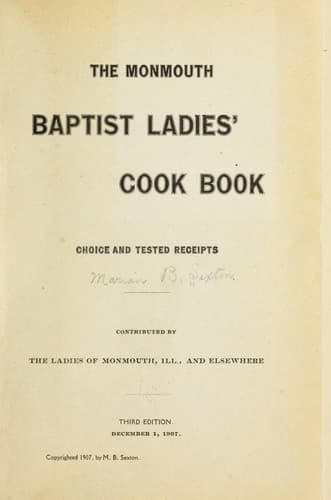
The Monmouth Baptist ladies' cook book
1907Marian B. Sexton · 147 readable pages · 842 recipe records · community household cookbook
From the librarian's dossier · AI-generated, grounded in the scanned text
The Monmouth Baptist Ladies' Cook Book (1907) is a community cookbook compiled through contributions from women in Monmouth, Illinois, and other American towns, including names as far-flung as Denver, Los Angeles, Pittsburgh, and even a submission attributed to Mrs. Wm. J. Bryan of Lincoln, Nebraska. With roughly 842 anchored recipes, it spans the full range of a turn-of-the-century American kitchen: stocks and soups, fish and shellfish, roasted and preserved meats, vegetables, salads, breads, pies, puddings, cakes, frozen desserts, breakfast dishes, pickles and preserves, invalid cookery, candy, and household remedies. Recipes are attributed to individual contributors, giving the book the character of a communal record as much as a culinary manual. Modern readers will find it a window into domestic life of the period, showing both everyday fare (corn bread, creamed eggs, pot roast) and more elaborate entertaining dishes (Charlotte Russe, Lady Baltimore Cake, Nesselrode Pudding). The book closes with an index and local business advertisements, anchoring it firmly as a fundraising or commemorative publication tied to a specific congregation and town. It offers a detailed, if unpolished, portrait of American home cooking and household management in 1907.
The book proceeds through a broad, loosely categorized sequence of courses and household topics rather than a strict alphabetical dictionary format. It opens with soups and fish (sections 1-2), moves into meats and vegetables (sections 2-4), then salads, dressings, and fried preparations like croquettes and fritters (sections 5-6). Breads and yeast work appear alongside pies (sections 6-7), followed by an extensive run of puddings (sections 7-8), cakes and cookies (sections 9-10), frozen desserts and breakfast dishes (section 11), more breakfast items, egg dishes, and pickles (section 12), preserves and invalid beverages (section 13), candy and household tips (section 14), and a closing miscellany of desserts and side dishes followed by an index and local advertisements (section 15). Recipes are consistently attributed to named contributors, and section headings function as informal category dividers rather than a formal table of contents.
Recipes from this book
842 records extracted from the text, showing the first 50 in reading order. Each links to a modern interpretation.
Read the book
147 readable pages. A dot marks pages with recipe records.