
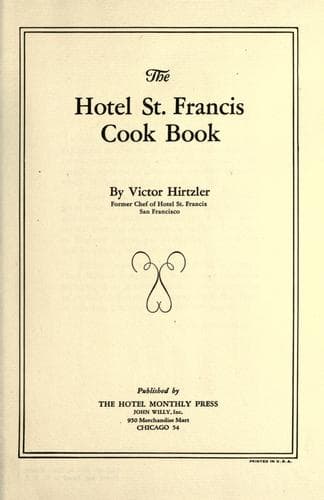
The Hotel St. Francis cook book
1919Hirtzler, Victor. · 311 readable pages · 1,440 recipe records · professional hotel cookbook with menu compendium
From the librarian's dossier · AI-generated, grounded in the scanned text
The Hotel St. Francis Cook Book is a 1919 professional cookbook by Victor Hirtzler, chef of San Francisco's Hotel St. Francis. It presents an enormous collection of recipes and full daily menus drawn from actual hotel service, organized around breakfast, luncheon, afternoon tea, supper, and dinner. The recipes reflect French-influenced haute cuisine as practiced in elite American hotel kitchens of the era, with classical sauces, elaborate composed dishes, and dishes named for people and places in the manner of the period. Alongside show dishes like Lobster Thermidor, Tournedos Rossini, and Baked Alaska, the book also includes practical foundations such as stocks, sauces, preserves, and pickles, revealing the full operation of a large hotel kitchen. The book is aimed at trained professional cooks rather than home cooks, assuming familiarity with classical French technique and terminology. Readers today will find it a rich window into the formal, multi-course dining culture of a major American hotel just after World War I, as well as a record of the culinary vocabulary, luxury ingredients, and theatrical presentation styles favored by fine dining establishments of the time. Its scale and specificity make it a valuable primary source for understanding hotel gastronomy of the early twentieth century.
The book is organized primarily as a sequence of dated or labeled daily menus (for example headings such as MAY 1 through MAY 17, LUNCHEON, SUPPER, BREAKFAST, AFTERNOON TEA, DINNER, and WEDDING DINNER) each followed by the detailed recipes needed to prepare the courses listed. This menu-then-recipe pattern repeats across most sections, moving through soups, eggs, fish, meats, vegetables, salads, and desserts within each meal. Later sections (such as section 11 and section 16) shift toward substantial runs of preserves, jellies, pickles, and canned fruit recipes. The book concludes with a recipe index and publisher promotional material for companion professional culinary titles, including The Epicurean and The Palmer House Cook Book, plus a final page of hotel management and service reference advertisements.
Recipes from this book
1,440 records extracted from the text, showing the first 50 in reading order. Each links to a modern interpretation.
Read the book
311 readable pages. A dot marks pages with recipe records.