
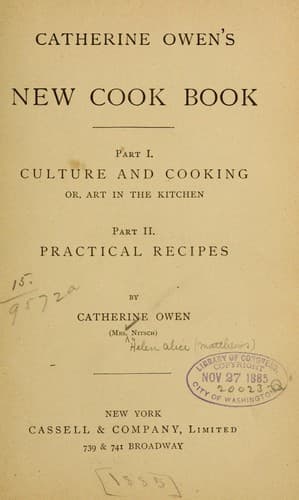
Catherine Owen's new cook book ..
1885Helen Alice (Matthews) Nitsch · 123 readable pages · 250 recipe records · general household cookbook
From the librarian's dossier · AI-generated, grounded in the scanned text
Catherine Owen's New Cook Book (1885) is a Victorian-era American cookbook that positions cooking as a refined domestic art rather than mere household drudgery. Attributed on the title page to Catherine Owen but catalogued under the author Helen Alice (Matthews) Nitsch, the book opens with a spirited defense of culinary knowledge as a mark of education and refinement, invoking French literary and aristocratic precedent to elevate the status of cookery. Structured in two parts, the book first lays out fundamental principles (bread, pastry, sauces, roasting, boiling, frying) before moving into an extensive collection of tested recipes ranging from luncheon dishes and warmed-over meats to entrees, poultry, game, salads, puddings, pies, sauces, and cakes. Owen shows a strong French influence throughout, citing figures like Gouffe and Soyer, while also addressing distinctly American and English household concerns such as economical cooking for small families and modest incomes. The book blends technical instruction (temperature testing, sauce consistency, frying fat management) with cultural commentary on food prejudices, household management, and thrift. It offers a window into upper-middle-class American domestic aspirations of the 1880s, where French culinary technique and English tradition were both prized markers of a well-run household.
The book is organized into two parts across roughly 34 numbered chapters (per the summaries) plus a closing index. Part I (sections 1 to 2 and beyond) covers foundational technique: bread, pastry, store-room essentials, sauces, frying, broiling, roasting, and boiling. Part II shifts into recipe-driven chapters covering luncheon dishes, small-household management, warmed-over meats, friandises and candies, economical cooking, vegetables, soups, fish, entrees, main meats and poultry, salads, puddings, pies, cheese dishes, savory sauces, and cakes. The book closes with an extensive alphabetical index (sections 12 to 13) that cross-references recipes and techniques throughout the volume. Chapters are frequently thematic rather than strictly sequential, mixing technique chapters with recipe chapters, and several sections show clear chapter numbering issues in the source material (garbled roman numerals and repeated headings), suggesting OCR distortion of the original chapter headers.
Recipes from this book
250 records extracted from the text, showing the first 50 in reading order. Each links to a modern interpretation.
Read the book
123 readable pages. A dot marks pages with recipe records.