
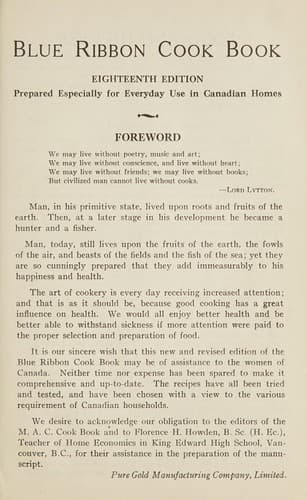
Blue Ribbon and Pure Gold cook book
1905Blue Ribbon Manufacturing Company · 92 readable pages · 413 recipe records · general household cookbook
From the librarian's dossier · AI-generated, grounded in the scanned text
The Blue Ribbon and Pure Gold Cook Book is a 1905 Canadian household manual published by the Blue Ribbon Manufacturing Company, produced as promotional and practical literature tied to Blue Ribbon and Pure Gold brand products. With 413 anchored food records, it offers a comprehensive survey of early twentieth-century domestic cookery, moving from scientific food classification and dietary guidance through soups, fish, meat, poultry, eggs, vegetables, salads, breads, baking, desserts, frozen treats, candies, canning, pickling, invalid cookery, and even bachelor and camp cooking. The book positions itself as both an educational text, opening with a foreword linking good cooking to civilization and health, and a commercial vehicle, repeatedly recommending its sponsoring brands' baking powder, spices, and seasonings. Modern readers will find it a rich window into how a Canadian home cook of the period was expected to plan meals, manage a kitchen, and stretch ingredients across everyday and special occasions. Its scope extends beyond recipes into household management, stove selection, and advice for the sick or those cooking without full kitchen facilities, making it as much a domestic guide as a recipe collection. The consistent branding throughout signals its origin as an advertising cookbook distributed to promote specific manufactured food products of the era.
The book is organized into nine broad sections that move from foundational knowledge to specialized cookery. It opens with food science, dietary guidance, meal planning, and table service before introducing soups (section 1). It then proceeds through fish, shellfish, sauces, and meats (section 2), poultry, game, eggs, and vegetables (section 3), continuing vegetables, salads, and bread making (section 4), baking staples like biscuits, muffins, and cakes (section 5), frostings, cookies, and puddings (section 6), frozen desserts and candies along with beverages, fruits, and the start of canning (section 7), canning, jelly and jam making, pickling, and invalid cookery (section 8), and concludes with bachelor and camp cooking, household hints, and stove and fuel guidance (section 9). Numbered headings and subheadings within each section (such as 'GAME,' 'YEAST,' or 'PROCESSING OR STERILIZING') indicate a structured reference format typical of household cookbooks of the period, with recipes grouped by food category and cooking method rather than alphabetically.
Recipes from this book
413 records extracted from the text, showing the first 50 in reading order. Each links to a modern interpretation.
Read the book
92 readable pages. A dot marks pages with recipe records.