
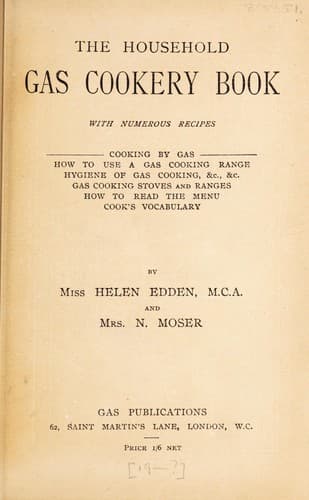
The household gas cookery book
1900Helen Edden · 146 readable pages · 512 recipe records · general household cookbook
From the librarian's dossier · AI-generated, grounded in the scanned text
The Household Gas Cookery Book, published in 1900 by Helen Edden, is a substantial recipe manual written to help households transition from coal to gas cooking. Anchored around 512 food-related records and just 2 household entries, the book is overwhelmingly a cookbook, though it closes with a modest cluster of domestic hints. It opens by making the case for gas as cleaner, cheaper, and more controllable than coal, then walks the reader through the mechanics of a gas range before launching into an extensive recipe program covering soups, fish, meats, poultry, game, vegetables, salads, eggs, pastry, sweets, preserves, sauces, breakfast dishes, and beverages. The recipes reflect a classical French-influenced style of the period, adapted with explicit instructions for gas jets, oven temperatures, and timing. Interspersed among the culinary content are practical household tips, from cleaning marble and carpets to removing stains and treating minor ailments, alongside a glossary of French culinary terms and guidance on reading gas meters. The book closes with an index organized alphabetically by dish type. For the modern reader, this is both a cookbook and a snapshot of an early twentieth-century kitchen in transition, useful for understanding how gas technology reshaped domestic cooking routines and expectations of the era.
The book proceeds from general instruction to specific recipe categories. Section 1 opens with advocacy for gas cooking, operating instructions for the range, and carving guidance before beginning the soup recipes. Sections 2 through 3 continue soups and move into fish selection and preparation. Sections 4 through 7 cover meats, poultry, and game in progressively specific detail, including joints, entrees, and wild game. Section 7 transitions into vegetables, which continue into section 8 alongside salads and eggs. Section 9 covers pastry and gas oven management for baking, moving into sweets, creams, and jellies. Section 10 continues with puddings, fruit dishes, and beverages. Section 11 covers more beverages, cakes, and bread, with detailed gas oven temperature guidance for baking. Section 12 addresses jam-making, pickles, sauces, and miscellaneous dishes. Section 13 mixes breakfast dishes, cheese preparations, leftovers, and household and personal care hints. Section 14 is devoted to household cleaning and maintenance advice, a French culinary glossary, and gas meter and gas fire guidance. Section 15 closes the book with a full alphabetical index of recipes and topics.
Recipes from this book
512 records extracted from the text, showing the first 50 in reading order. Each links to a modern interpretation.
Read the book
146 readable pages. A dot marks pages with recipe records.