
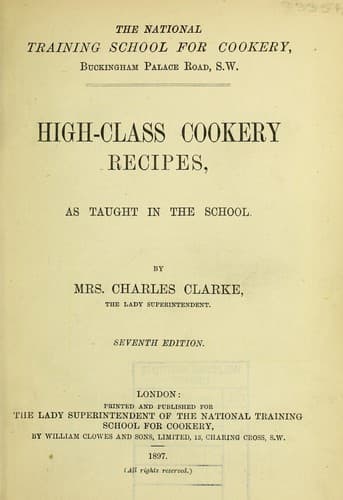
High-class cookery recipes
1897Edith Nicolls Clarke · 87 readable pages · 376 recipe records · professional household and haute cuisine cookbook
From the librarian's dossier · AI-generated, grounded in the scanned text
High-Class Cookery Recipes (1897) is a professional-level Victorian cookbook compiled under the auspices of the National Training School for Cookery in London, with Edith Nicolls Clarke credited as author and Mrs. Charles Clarke named as Lady Superintendent. The book presents 376 anchored recipes moving from foundational stocks and consommes through fish, curries, elaborate French-style entrees, vegetables, savouries, puddings, iced desserts, and cakes. Its recipes are heavily inflected by classical French technique and nomenclature, with dishes named a la Bearnaise, a la Pompadour, and a la Talleyrand appearing alongside curries described as taught by a native cook at the Colonial and Indian Exhibition of 1886. The text assumes a trained kitchen audience capable of clarifying consommes, making quenelles, larding meats, and managing egg-based liaisons without curdling. Advertisements for period products open the volume, alongside an essay framing cookery as an art. Readers today will find a window into the aspirations and technical standards of formal English kitchen instruction at the close of the nineteenth century, including an unusual personal touch: the author cites recipes drawn from her grandfather's manuscripts, identified as Thomas Love Peacock. The book closes with cakes, breads, and a substantial index confirming its scope as a 260-page manual of haute cuisine.
The book proceeds through a fixed sequence of courses: opening matter and advertisements, then stocks and soups, dressed fish, curries and Indian dishes, French entrees of meat and game, sauces and delicacies such as sweetbreads and kidneys, vegetables and savouries, pastry and omelets, hot puddings and souffles, creams and jellies, iced desserts and moulded puddings, and finally cakes, breads, and an index. Section headings within the text (such as VEGETABLES AND SALADS, SAVOURIES, and CREAMS, JELLIES, ICES, COLD SWEETS) mark clear category divisions, and recipes are grouped by dish type rather than by meal or occasion, consistent with a professional training-school reference organized for lookup by course.
Recipes from this book
376 records extracted from the text, showing the first 50 in reading order. Each links to a modern interpretation.
Read the book
87 readable pages. A dot marks pages with recipe records.