
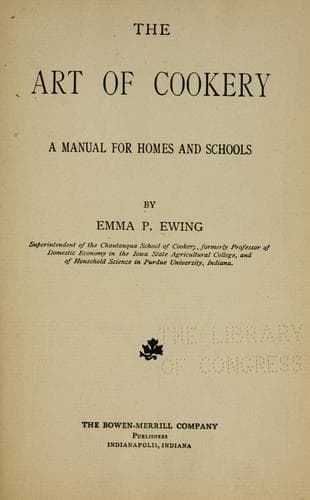
The art of cookery
1899Emma P. Ewing · 161 readable pages · 681 recipe records · general household cookbook
From the librarian's dossier · AI-generated, grounded in the scanned text
The Art of Cookery (1899) by Emma P. Ewing is a comprehensive American household cookbook organized around principles of method rather than mere recipe listing. Structured in parts covering marketing, cooking methods, mixing, seasoning, and serving, the book teaches the home cook not just what to make but why particular techniques work, drawing on what the author calls scientific principles of heat, moisture, and ingredient behavior. It opens with detailed guidance on selecting meats, vegetables, and fruits at market, then moves through broiling, roasting, boiling, frying, and stewing before addressing soups, sauces, breads, pastries, puddings, cakes, frozen desserts, salads, entrees, eggs, and finally carving and menu planning. With 681 anchored food records, the book offers an extensive practical repertoire spanning everyday fare and more elaborate entertaining dishes. It also includes sections on invalid cookery for the sick-room and canning and preserving for the pantry, reflecting the full scope of a period household's food responsibilities. Readers today will find a text that is didactic and confident in tone, invested in correcting what the author sees as common kitchen errors, and organized with an eye toward teaching transferable technique. The book closes with sample menus and an alphabetical index, underscoring its intent as both a teaching manual and a lasting kitchen reference.
The book is arranged in numbered parts and chapters that move from preparatory knowledge to finished presentation. Part I covers marketing and selecting raw ingredients (section 1). This is followed by chapters on methods of cooking, including broiling, baking and roasting, boiling, steaming, and stewing (sections 2 through 5), then soup-making and sauces (sections 5 and 6), frying and sick-room cookery (section 7), and canning, preserving, and pickling (section 8). Part IV, on mixing, covers bread-making, pastry and pies, puddings and sauces, cake-making, and delicate frozen desserts (sections 9 through 12). Part V, on seasoning, addresses salad-making and entrees using creamed and leftover preparations (sections 13 and 14). The book closes with egg cookery, carving, bills of fare, and an alphabetical index (sections 15 and 17). Chapter numbering and part divisions are explicit in the headings throughout, suggesting the book was designed as a structured course in cookery rather than a loose recipe collection.
Recipes from this book
681 records extracted from the text, showing the first 50 in reading order. Each links to a modern interpretation.
Read the book
161 readable pages. A dot marks pages with recipe records.