
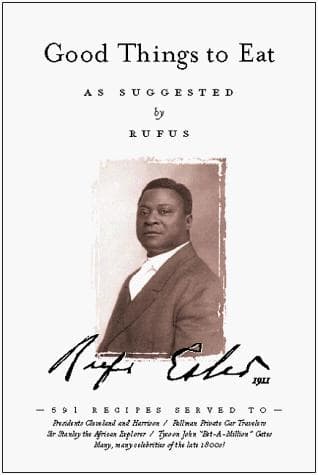
Good Things to Eat as Suggested by Rufus
1911Rufus Estes · 94 readable pages · 533 recipe records · general household cookbook
From the librarian's dossier · AI-generated, grounded in the scanned text
Good Things to Eat as Suggested by Rufus is a 1911 cookbook by Rufus Estes, a chef who rose from slavery to prepare meals for Pullman Company dining cars and U.S. Steel subsidiaries, and who cooked for prominent figures including Presidents Cleveland and Harrison. The book opens with a foreword and a biographical sketch of Estes, followed by practical hints for kitchen staff and a table of weights and measures, before moving into more than 500 anchored recipes across soups, fish, meats, poultry, vegetables, sauces, breads, cakes, desserts, preserves, and beverages. The recipes combine French culinary technique with American household practicality, reflecting Estes' professional experience serving both elegant dining-car and formal meals as well as everyday domestic cooking. Sections move in a fairly traditional cookbook sequence, from soups and fish through meats, vegetables, baked goods, and desserts, ending with preserves, beverages, and a detailed alphabetical index. Modern readers will find a rich record of early twentieth-century American cooking as practiced by a professional African American chef, with attention to economy, presentation, and technique. The book stands as both a practical manual and a historical document of its author's remarkable career and culinary skill.
The book begins with front matter (section 1): a foreword, a biographical sketch of Rufus Estes, hints for kitchen maids, and a table of weights and measures. It then proceeds recipe-category by recipe-category: soups and fish (section 1), meats and salads (section 2), poultry and stuffings (section 3), vegetables, game, eggs, and condiments (section 4), more vegetables and sauces (section 5), sauces, breads, rolls, and pies (section 6), cakes and desserts (section 7), confections, ice creams, and preserves (section 8), cake fillings, puddings, and beverages (section 9), and finally a comprehensive alphabetical index with two beverage recipes shown in detail (section 10). The organization follows a broadly conventional household cookbook arrangement, moving from savory to sweet courses and ending with preservation and reference material.
Recipes from this book
533 records extracted from the text, showing the first 50 in reading order. Each links to a modern interpretation.
Read the book
94 readable pages. A dot marks pages with recipe records.