
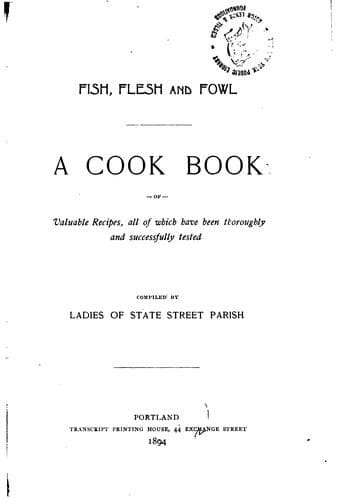
Fish, Flesh and Fowl: A Cook Book of Valuable Recipes, All of which Have ...
1894Ladies of State Street Parish · 36 readable pages · 246 recipe records · general household cookbook
From the librarian's dossier · AI-generated, grounded in the scanned text
Fish, Flesh and Fowl is an 1894 American community cookbook compiled by the Ladies of State Street Parish, typical of church fundraising cookbooks of its era. Drawing on 246 anchored food records across four sections, it surveys late nineteenth-century domestic cookery in a logical progression: breads and soups, then fish, meat, and poultry, followed by eggs, vegetables, salads, pies, puddings, and frozen desserts, and finally cakes, preserves, pickles, beverages, candies, chafing-dish cookery, and dishes for invalids. The book functions as a working kitchen reference rather than a literary work, likely assembled from recipes contributed by parish members and neighbors. It captures household expectations of the period, including home baking with yeast and baking powder, guidance on selecting quality cuts of meat, extensive preserving and pickling for pantry storage, and a dedicated section for preparing food for the sick. For a modern reader, it offers a detailed window into ingredients, techniques, and priorities of an American household near the turn of the century, from everyday staples like brown bread and chicken pie to more elaborate entertaining fare like chafing-dish preparations and frozen desserts. Its organization and content suggest a practical, comprehensive resource meant for daily use rather than aspirational display.
The book is organized by course and category rather than alphabetically throughout, beginning with bread and soups in section 1, followed by fish, meat, and poultry preparations. Section 2 continues with poultry, eggs, vegetables, salads, pies, puddings, and frozen desserts. Section 3 shifts to an alphabetically arranged cake chapter followed by frostings, then preserves and pickled condiments. Section 4 closes the volume with pickles, jellies and preserves, beverages, candies, chafing-dish cooking, and dishes for invalids, ending with what appears to be the start of an index.
Recipes from this book
246 records extracted from the text, showing the first 50 in reading order. Each links to a modern interpretation.
Read the book
36 readable pages. A dot marks pages with recipe records.