
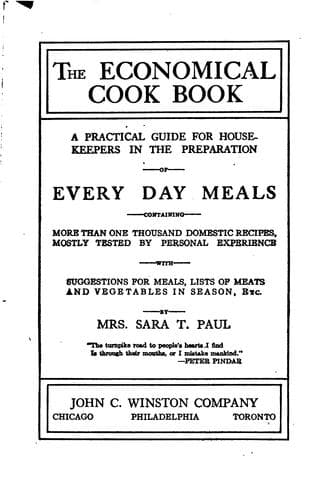
The economical cook book
1905Sara T. Paul · 150 readable pages · 670 recipe records · general household cookbook
From the librarian's dossier · AI-generated, grounded in the scanned text
The Economical Cook Book is a 1905 American household cookbook by Sara T. Paul, organized around the practical needs of a home kitchen of the period. It moves through the full arc of a household's cooking demands, from soups and fish through meats, poultry, vegetables, breads, pastries, puddings, cakes, confectionery, beverages, and fruit preservation. Paul's introduction frames the collection as drawn from personal tested experience rather than compiled wholesale from other sources, and the book repeatedly stresses economy: using all parts of an animal, adapting leftovers, and offering practical guidance for cooks who may be inexperienced. With 670 anchored food records and only a single medicinal entry, this is overwhelmingly a working culinary manual rather than a domestic medicine guide. Modern readers will find a detailed window into turn-of-the-century American cookery, including now-uncommon dishes like scrapple, calf's head, mock turtle soup, and boned turkey with aspic, alongside familiar staples like bread, pies, and cakes. The book's scope and level of detail suggest it was meant as a comprehensive single-volume reference for a household cook, covering both everyday economical fare and more elaborate dishes suited to entertaining.
The book is organized into thematic sections that follow a fairly conventional cookbook progression of the era: soups and fish open the collection, followed by beef, mutton, lamb, pork, and veal, then poultry and game. From there it moves to salads, croquettes, eggs, omelets, and sauces, then vegetables and bread. The back half is devoted to pastry, puddings, molded desserts, cakes, cookies, confectionery, beverages, and finally preserving, canning, and pickling. Section 12 is missing from the provided material, so the sequence jumps from section 11 to section 13. Each section groups many numbered variants of a dish (for example multiple brown breads or brandied peaches), reflecting a reference-style structure where cooks could choose among several tested versions of the same preparation.
Recipes from this book
670 records extracted from the text, showing the first 50 in reading order. Each links to a modern interpretation.
Read the book
150 readable pages. A dot marks pages with recipe records.