
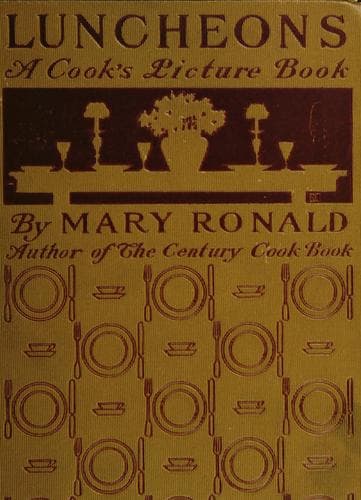
Luncheons
1902Mary Ronald · 81 readable pages · 222 recipe records · formal menu-based luncheon cookbook
From the librarian's dossier · AI-generated, grounded in the scanned text
Luncheons (1902) by Mary Ronald is a specialized cookbook devoted entirely to the formal midday meal, presented as a supplement to the author's earlier Century Cook Book. Subtitled as a kind of picture book for cooks, it treats luncheon as the American counterpart to the French dejeuner, a meal typically hosted for and attended by women. Rather than a general household manual, the book is organized around the structure of a multi-course luncheon menu, moving course by course from garnishing principles through eggs, fish, meats, salads, sauces, cheese, and an extensive run of desserts, cakes, and breads. Throughout, Ronald pays close attention to presentation, arguing that even simple dishes gain value through careful garnishing, molding, and decorative technique. The recipes assume a well-stocked kitchen and a cook comfortable with French culinary vocabulary and elaborate plating for buffet and table service. Modern readers will find it a window into upper-class entertaining customs of the early twentieth century, with detailed instruction on table setting, invitations, and course order alongside the recipes themselves. It closes with a substantial alphabetical index, making it as much a reference tool as a narrative cookbook.
The book opens with an introductory chapter on the conduct and etiquette of luncheon entertaining, including table settings, seating, invitations, and decoration, before turning to general principles of garnishing and dishing. From there it is organized by the courses of a formal luncheon, moving sequentially through first-course items like canapes and cocktails, soups, egg dishes, fish and shellfish, meat courses (explicitly labeled as chapters such as the Sixth Course), sauces and cheese, salads and cold aspic dishes, and then an extended dessert sequence covering puddings, souffles, ices, tartlets, and pies. Later chapters shift to loaf cakes, small fancy cakes, meringues, icings, and finally breads, rolls, and sandwiches. The book ends with an alphabetical index spanning the final section, allowing readers to locate recipes by name rather than by course.
Recipes from this book
222 records extracted from the text, showing the first 50 in reading order. Each links to a modern interpretation.
Read the book
81 readable pages. A dot marks pages with recipe records.