
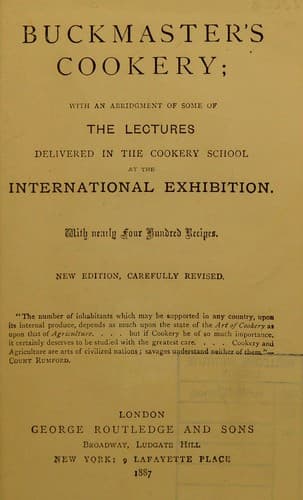
Buckmaster's cookery
1887J. C. Buckmaster · 136 readable pages · 317 recipe records · general household cookbook with domestic economy essays
From the librarian's dossier · AI-generated, grounded in the scanned text
Buckmaster's Cookery is a Victorian domestic cookbook first published in 1887, blending practical recipes with social commentary on household management and women's education. The author, J. C. Buckmaster, opens not with recipes but with a historical lecture on English food traditions from Ancient Britons through the Anglo-Saxon and post-Reformation periods, framing cookery as vital to national welfare. The book then moves through arguments for reforming girls' education to include domestic training, discussions of servant management, and a section on the physiological basis of nutrition, before settling into the bulk of its content: hundreds of recipes covering stocks, soups, stews, puddings, pastries, cakes, fish, sauces, vegetables, curries, poultry, and frozen desserts. Recipes are anchored throughout by imperial measurements and detailed step-by-step instruction with specific precautions for the cook. The book closes with an alphabetical index for practical reference. Modern readers will find this both a working kitchen manual for a Victorian middle-class household and a window into contemporary debates about domestic economy, servant relations, and the proper education of women. It reflects the era's preoccupation with thrift, technique, and the moral weight placed on the well-run household kitchen.
The book opens with discursive, essay-like material (sections 1 through 3) covering food history, household reform, girls' education, servant management, and nutrition science, before transitioning into recipe content proper. From section 4 onward the book is organized by category: foundational stocks and techniques, an extensive run of soups (sections 5 and 6), stews and hashes with puddings (sections 6 through 8), pastries and cakes (sections 8 and 9), fish (section 9), sauces and the beginning of vegetables (section 10), an extended vegetable and curry section (section 11), meat and poultry utilization with omelettes, salads, and jellies (section 13), and finally frozen desserts and an alphabetical index (section 14). Note that section 12 is absent from the provided material, so there is a gap between the vegetable and curry content of section 11 and the meat and poultry content of section 13.
Recipes from this book
317 records extracted from the text, showing the first 50 in reading order. Each links to a modern interpretation.
Read the book
136 readable pages. A dot marks pages with recipe records.