
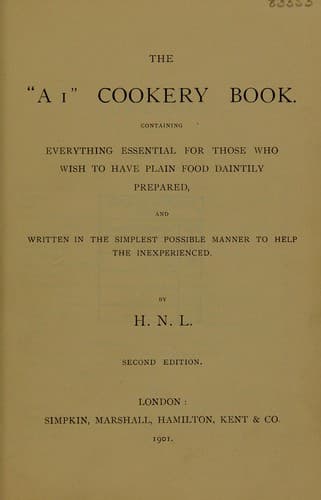
The "A1" cookery book
1901H. N. L. · 112 readable pages · 502 recipe records · general household cookbook
From the librarian's dossier · AI-generated, grounded in the scanned text
The "A1" Cookery Book (1901) is a practical British household manual by an author identified only as H. N. L., aimed squarely at inexperienced housekeepers who need to run a kitchen on a fixed weekly budget. It opens with guidance on allocating roughly 10 shillings per person weekly across the butcher, grocer, dairy, baker, greengrocer, and fishmonger, then moves methodically through the courses of a Victorian and Edwardian meal: soups and stocks, fish, meat, poultry and game, sauces, puddings and sweets, cakes and baking, breakfast and savoury dishes, preserves, and household odds and ends. The book blends everyday recipes with more elaborate set pieces such as Christmas plum pudding, aspic jelly, and salmagundi, alongside plainer fare like hot pot and Irish stew. It also addresses invalid cookery, home remedies for stains and tarnish, and beverages such as ginger beer and coffee percolation. With over 500 anchored food records and a single medicinal entry, this is overwhelmingly a cookery text, though it carries traces of the era's broader domestic advice literature. Readers today will find it a useful window into turn-of-the-century British household management, menu planning philosophy, and the technical vocabulary of stove-based, from-scratch cooking.
The book is organized by course and category in a logical kitchen sequence: an introductory section on household budgeting and menu principles (section 1), followed by soups and fish (sections 1-2), meats (section 4), poultry and game (section 5), sauces and puddings (section 7), further puddings, pastries, and desserts (sections 8-9), cakes, breads, and breakfast or savoury dishes (sections 9-10), preserves, confections, and household cleaning recipes (section 11), and a closing alphabetical index with advertisements (section 12). Numbered sections generally track the printed page ranges of the original book, moving from opening instructional matter through recipe categories to the back-of-book index.
Recipes from this book
502 records extracted from the text, showing the first 50 in reading order. Each links to a modern interpretation.
Read the book
112 readable pages. A dot marks pages with recipe records.