
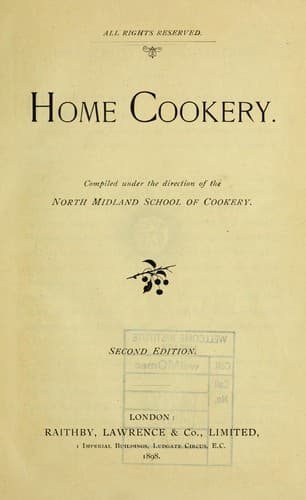
Home cookery
1898North Midland School of Cookery · 92 readable pages · 311 recipe records · general household and institutional cookbook
From the librarian's dossier · AI-generated, grounded in the scanned text
Home Cookery (1898) is a practical instructional cookbook compiled by the North Midland School of Cookery, a British institution training cooks in late Victorian domestic and formal culinary technique. The book moves from foundational cooking methods (roasting, boiling, stewing, frying) through breakfast dishes, soups, fish, meat and poultry entrees, game, vegetables, puddings, pastry, cold sweets, savories, sauces, bread and cakes, confectionery, and preservation methods, closing with an alphabetical index. It draws heavily on classical French culinary vocabulary and technique (chaudfroid, quenelles, aspic, Hollandaise) alongside plainer British fare (Yorkshire pudding, scones, gingerbread), reflecting the blended formal-and-domestic training model of the school. Recipes are precise and instructional in tone, aimed at cooks in training or household service rather than casual home cooks, with attention to timing, temperature, and presentation. Readers today will find it a window into the structure of a formal English household kitchen at the close of the nineteenth century, showing how a single institution taught everything from stock-making to elaborate iced cakes and calves'-foot aspic. It is not a narrative or anecdotal cookbook but a technical manual, organized for reference and instruction, with an index for locating specific preparations across its ten sections.
The book proceeds through sequential culinary categories: cooking methods and breakfast dishes (section 1), cold dishes and soups with fish preparation (section 2), fish and French-style meat entrees (section 3), meat and poultry (section 4), game, vegetables, salads, and puddings (section 5), pastry and cold sweets (section 6), savories, cheese dishes, pies, and cold meat cookery (section 7), sauces and bread and cakes (section 8), advanced cakes, confectionery, and preservation methods (section 9), and a comprehensive alphabetical index with publisher notices (section 10). Headings within sections mark specific dish categories and techniques rather than broad chapter titles, suggesting a manual meant for step-by-step consultation.
Recipes from this book
311 records extracted from the text, showing the first 50 in reading order. Each links to a modern interpretation.
Read the book
92 readable pages. A dot marks pages with recipe records.