
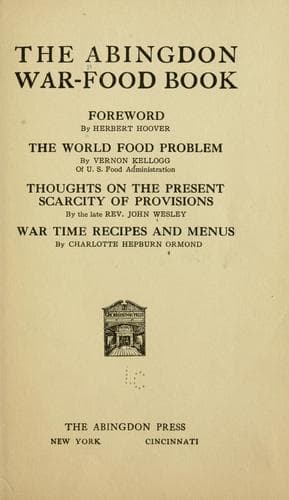
The Abingdon war-food book
1918Herbert Clark Hoover, Vernon L. Kellogg, John Wesley · 12 readable pages · 56 recipe records · wartime food conservation cookbook
From the librarian's dossier · AI-generated, grounded in the scanned text
The Abingdon War-Food Book is a compact 1918 American cookbook produced in the context of World War I food conservation efforts. It brings together contributions from Herbert Hoover and Vernon L. Kellogg of the U.S. Food Administration alongside a historical essay by John Wesley on eighteenth-century food scarcity, and practical recipes attributed to Charlotte Hepburn Ormond. The book opens by framing the war as a world food problem, discussing rationing in Allied nations such as Belgium and urging American readers toward conservation and substitution in their kitchens. It then moves into practical territory with soups, meat dishes, meat substitutes, salads, desserts, breads, and a set of ten complete meatless day menus. Throughout, the recipes reflect the constraints of the period, favoring alternative grains, legumes, and reduced meat and wheat consumption. Modern readers will find this a small but historically dense document, combining persuasive wartime rhetoric with everyday recipes designed to help households comply with federal food guidance. It is as much a civic and propaganda document as a culinary one, offering a window into how ordinary American cooking was reshaped by wartime scarcity and official conservation campaigns.
The book is organized into two main sections. Section 1 opens with front matter, a foreword, and essays on the world food problem and historical provisioning scarcity, then transitions into wartime recipes and menus covering soups, meats, meat substitutes, salads, and desserts. Section 2 continues the recipe material with a dedicated breads chapter and concludes with ten meatless day menus that combine the preceding recipes into complete meal plans emphasizing vegetables, legumes, eggs, and dairy in place of meat.
Recipes from this book
56 records extracted from the text, showing the first 50 in reading order. Each links to a modern interpretation.
Read the book
12 readable pages. A dot marks pages with recipe records.