
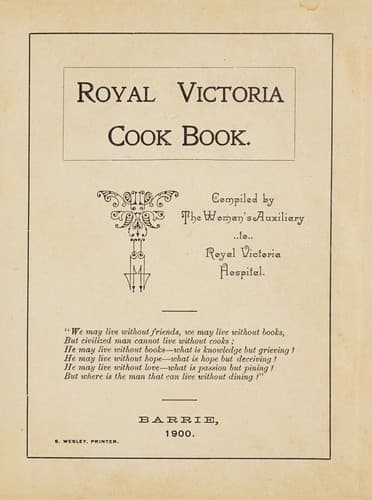
Royal Victoria cook book
1900Ont.). Woman's Auxiliary Royal Victoria Hospital (Barrie · 79 readable pages · 561 recipe records · general household cookbook (community fundraising cookbook)
From the librarian's dossier · AI-generated, grounded in the scanned text
The Royal Victoria Cook Book is a community fundraising cookbook compiled in 1900 by the Woman's Auxiliary of the Royal Victoria Hospital in Barrie, Ontario. Like many charitable cookbooks of its era, it gathers recipes contributed by local women to raise money for hospital comforts, and it offers a rich snapshot of turn-of-the-century Canadian household cookery. With over 560 anchored food records, the book spans soups, fish, meats, vegetables, salads, puddings, pies, desserts, cakes, breads, beverages, confectionery, and invalid cookery for the sick room. Readers will find both everyday economical dishes intended for ordinary housekeepers and more elaborate entertaining fare such as Charlotte Russe and Lobster a la Newborg. The volume also preserves practical domestic knowledge of the period, including kitchen measurement tables, cooking time charts, sample menus, and household cleaning advice, alongside period advertisements from local Barrie merchants. Because it was compiled from contributions by named local women rather than written by a single professional author, the book reflects a communal, domestic voice typical of charitable fundraising cookbooks. For the modern reader, it offers both a practical historical recipe resource and a window into the social and medical concerns of a small Ontario hospital community at the turn of the twentieth century.
The book is organized into broad culinary categories that follow a fairly conventional sequence for household cookbooks of the period: soups and fish open the collection, followed by meats, poultry, game, and sauces, then vegetables and salads, then puddings, pies, and desserts, then cheese dishes and baked goods, then cakes, and finally beverages, confectionery, and invalid cookery. The final section also contains practical household reference material, including kitchen rules, a cooking time table, and sample breakfast and dinner menus, interspersed with period advertisements for local Barrie businesses and household equipment. Section headings within the summaries (SOUPS, FISH AND OYSTERS, BEEF, VEAL, POULTRY, GAME, VEGETABLES, SALAD DRESSING, PIES, DESSERTS, CAKES, CONFECTIONERY, KITCHEN RULES, TIME TABLE) indicate the book relies on subject-based chapter divisions rather than alphabetical or menu-based organization. Note that section 7 is absent from the provided summaries, suggesting a gap in the mechanically gated material between sections 6 and 8.
Recipes from this book
561 records extracted from the text, showing the first 50 in reading order. Each links to a modern interpretation.
Read the book
79 readable pages. A dot marks pages with recipe records.