
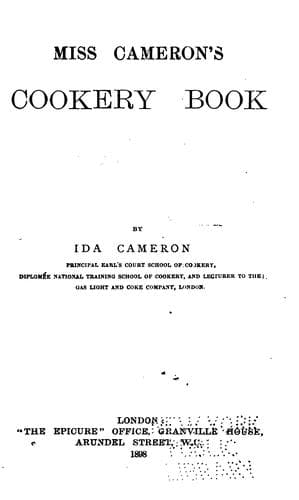
Miss Cameron's cookery book
1898Ida Cameron · 93 readable pages · 520 recipe records · general household cookbook
From the librarian's dossier · AI-generated, grounded in the scanned text
Miss Cameron's Cookery Book (1898) is a substantial late-Victorian culinary manual attributed to Ida Cameron, who ran the Earl's Court School of Cookery. Drawing on the corpus of anchored records (520 food-related entries and a single medicinal entry), the book ranges widely across fish and seafood, elaborate French-influenced entrees, sauces, pies, sausages, vegetables, eggs, pastries, puddings, creamed desserts, ices, breads, and cakes, closing with an index and advertisements for Cameron's own cooking school. The recipes move from simple boiled and plain preparations to highly worked haute-cuisine dishes involving boning, braising, galantines, and molded presentations, reflecting the aspirational Continental style fashionable in well-to-do British and American households of the period. Alongside grand entrees featuring truffles, foie gras, and game birds, the book also includes homelier fare such as pies, sausages, and savory butters, giving a sense of a household cook expected to serve both everyday meals and formal courses. Modern readers will find a text firmly rooted in its era's ingredients, techniques, and commercial branding, offering a window into upper-middle-class domestic cookery and cookery-school instruction at the close of the nineteenth century.
The book is organized by course and dish type, moving from fish and seafood (section 2) into elaborate meat and poultry entrees (section 3), then sauces, pies, sausages, and vegetables (section 5), eggs and pastries leading into puddings (section 6), and creamed desserts, ices, breads, and cakes (section 8). It concludes with a multi-part index covering savory dishes, forcemeats, potted meats, pastry and sweets, a miscellaneous 'scraps' section including preserves and invalid cookery, and advertisements for Cameron's cooking school and contemporary gas cookers (section 10). The structure suggests a logical progression through a formal multi-course household menu, from fish through entrees to sweets, with reference material and promotional content appended at the end.
Recipes from this book
520 records extracted from the text, showing the first 50 in reading order. Each links to a modern interpretation.
Read the book
93 readable pages. A dot marks pages with recipe records.