
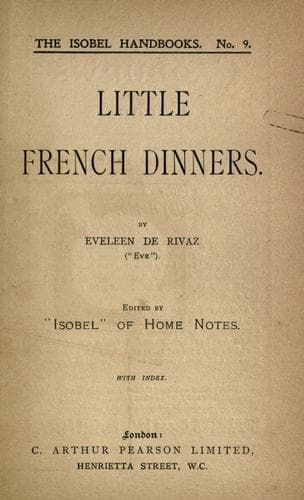
Little French dinners
1898Eveleen De Rivaz · 65 readable pages · 203 recipe records · French-influenced menu cookbook
From the librarian's dossier · AI-generated, grounded in the scanned text
Little French dinners (1898) is a practical menu-based cookbook by Eveleen De Rivaz, the ninth volume in the Isobel Handbooks series. Aimed at English households employing plain cooks rather than trained chefs, it teaches readers how to host small Anglo-French dinner parties for six to eight guests without excessive cost or difficulty. The book's core structure is thirty complete dinner menus, each moving through soup, fish, meat, vegetable, and dessert courses in the French service style, with detailed instructions for every dish. Recipes carry both French and English titles, reflecting an aspiration toward refined continental cooking adapted for the ordinary English kitchen. Beyond the menus, the book closes with practical supplementary chapters on savoury toasts, using up stale bread, composing seasonable and fancy salads, cooking macaroni, and preparing hashed mutton and braised beef, rounding out its usefulness for everyday cooking as well as entertaining. Throughout, the author stresses that all recipes were tested in her own household, positioning the book as a reliable, hands-on guide rather than an abstract culinary treatise. For modern readers, it offers a window into genteel English domestic entertaining at the close of the nineteenth century, filtered through French culinary fashion.
The book is organized as a sequence of thirty numbered dinner menus (Menu I through Menu XXX), each menu presenting a full multi-course sequence of soup, fish, meat, vegetable, and dessert recipes with detailed instructions. These menus occupy sections 1 through 5. Section 5 also introduces variant dinner formats, including an economical dinner with prices listed per dish, a maigre (meatless) dinner, and a case dinner served in ramequin dishes. Section 6 departs from the menu format to offer standalone topical chapters: savoury toasts, uses for stale bread, seasonable and fancy salads, macaroni cookery, and hashed mutton and braised beef preparation. A table of contents at the start (section 1) outlines this full structure in advance.
Recipes from this book
203 records extracted from the text, showing the first 50 in reading order. Each links to a modern interpretation.
Read the book
65 readable pages. A dot marks pages with recipe records.