
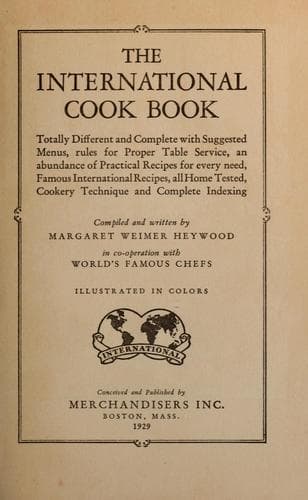
The international cook book
1929Margaret Weimer Heywood · 157 readable pages · 0 recipe records · general household cookbook with an international recipe supplement
From the librarian's dossier · AI-generated, grounded in the scanned text
The International Cook Book (1929) by Margaret Weimer Heywood is a large American household cookbook that blends everyday domestic cookery with recipes attributed to chefs at prestigious hotels and ocean liners around the world. Anchored to 873 individual food records, the book positions itself as a complete kitchen reference for the homemaker, covering menu planning, table service and etiquette, everyday recipes for breads, cakes, preserves, meats, fish, and desserts, plus a dedicated section of international dishes from establishments in France, Italy, Japan, Mexico, Turkey, Greece, Germany, Austria, Palestine, and beyond. It closes with practical cookery technique: buying food, storeroom management, garnishing, carving, reference charts for oven and frying temperatures, cooking times, weights and measures, and calorie information. The book is explicitly organized into five sections, moving from entertaining and menus through recipes, international recipes, cookery technique, and an index. Its dual identity, part guide to gracious home entertaining and part showcase of professional restaurant cuisine, makes it a useful window into how upper-middle-class American households in the late 1920s imagined both domestic routine and cosmopolitan dining. Modern readers will find it a rich but dated resource, valuable for understanding period foodways, service customs, and the era's fascination with international culinary prestige, but requiring translation of its measurements, temperatures, and vocabulary for contemporary kitchens.
The book is divided into five sections as stated in section 1: menus and table service, recipes, international recipes, cookery technique, and an index. Section 1 opens with introductory material and meal service guidance; sections 2 and 3 cover dinners, suppers, teas, children's and invalid cookery, and picnics before introducing the recipe chapters. Sections 4 through 11 present the core recipe chapters in a numbered chapter sequence (Chapters XIII through XXV as referenced in headings), covering breads, cakes, icings and candies, preserves and cookies, desserts and fish, frozen dishes and fruit, meats and meat substitutes, and eggs, pancakes, pies, and poultry. Sections 14 and 15 form the international recipes portion, organized by contributing hotels, chefs, and countries rather than by dish type. Section 15 also begins the cookery technique material, continued in section 16, which provides reference charts, garnishing and carving instruction, and a fifty-tip practical guide. Sections 12 and 13 were not included in the provided summaries.
Read the book
157 readable pages. A dot marks pages with recipe records.