
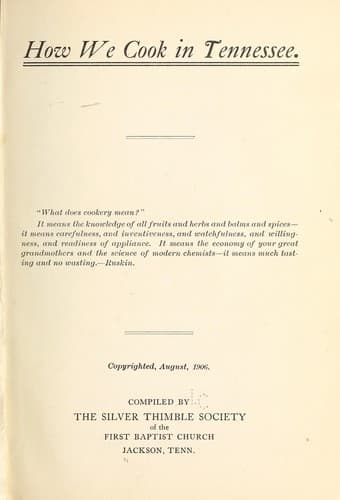
How we cook in Tennessee ..
1906Jackson (Tenn.). First Baptist Church. The Silver Thimble Society. · 174 readable pages · 1,031 recipe records · general household and community church cookbook
From the librarian's dossier · AI-generated, grounded in the scanned text
How We Cook in Tennessee is a 1906 community cookbook compiled by the Silver Thimble Society of Jackson, Tennessee's First Baptist Church. Like many church and club cookbooks of its era, it gathers recipes contributed by named individuals and drawn from regional sources and established culinary authorities, blending everyday household cooking with more ambitious entertaining fare. The book moves from soups and fish through meats, game, eggs, vegetables, breads, cakes, puddings, frozen desserts, beverages, preserves, candy, and pickles, before closing with remedies for the sick, a poison antidote chart, sample menus, and an index. Its contents reflect the domestic culture of a prosperous Southern Baptist congregation at the turn of the twentieth century, with recipes ranging from simple cornbreads and soused pork to elaborate ice creams, Charlotte Russe, and formal luncheon menus. With 1,031 anchored food records and only a single medicinal entry, this is overwhelmingly a cooking manual, though it preserves traces of period household medicine and etiquette. Modern readers will find it a rich window into early 1900s Southern foodways, entertaining customs, and the community fundraising cookbook tradition, complete with contributor names, advertising, and period poetry celebrating domestic arts like the chafing dish and salad-making.
The book is organized into sixteen recovered sections that follow a broadly progressive menu logic: soups and fish open the collection (sections 1-2), followed by oysters, sauces, and meats including pork, beef, veal, lamb, and poultry (sections 2-4), then game, eggs, cheese, and croquettes (section 4). Chafing dish cookery, sandwiches, and salads follow (sections 5-6), then vegetables, cereals, breads, and rolls (sections 6-8), leading into an extensive cake section with general directions, fillings, and icings (sections 8, 10-11). Puddings and pastry rules appear next (section 11), followed by sweet sauces, fruit preparations, and a large block of ice creams and frozen desserts (sections 13-14). The book then turns to jellies, beverages, and preserves (section 15), canned goods and candy (section 16), pickles, remedies for the sick, poison antidotes, and miscellany (section 17), and closes with sample menus, a glossary of French culinary terms, and a full index (section 18). Headings within sections mark specific categories such as SOUPS, OYSTERS, CAKE, PUDDINGS, BEVERAGES, and PRESERVES AND JELLIES, and many recipes are attributed to named contributors, consistent with a church fundraiser format.
Recipes from this book
1,031 records extracted from the text, showing the first 50 in reading order. Each links to a modern interpretation.
Read the book
174 readable pages. A dot marks pages with recipe records.