
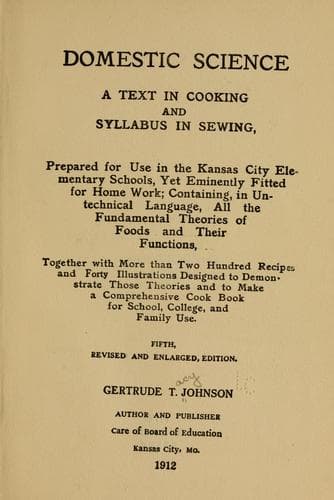
Domestic science (Johnson, for schools and homes)
1911Gertrude Tacy Johnson · 73 readable pages · 0 recipe records · school domestic science textbook and cookbook
From the librarian's dossier · AI-generated, grounded in the scanned text
Domestic Science by Gertrude Tacy Johnson is a 1911 textbook designed for classroom instruction in cooking and household management, aimed at seventh and eighth grade students in American schools. Structured as a formal syllabus, it merges food chemistry with hands-on kitchen technique, walking students through the composition of foods (starches, sugars, albumen, casein, gluten) alongside practical lessons in cooking meats, breads, vegetables, and desserts. The book reflects an educational philosophy that ties nutrition science, hygiene, and household economy directly to daily cooking tasks performed in a school setting. Beyond cooking, it incorporates a parallel sewing curriculum, situating the text within a broader domestic science movement that treated home skills as subjects worthy of rigorous, graded instruction. Recipes range from basic preparations like boiled eggs and rolled oats to more elaborate items such as angel cake, mock bisque soup, and various pickles and preserves. The book closes with equipment specifications for school kitchens, a bibliography of scientific sources, and period advertisements for cookbooks, dressmaking texts, and domestic science furniture. For modern readers, it offers a window into how cooking was taught as applied science in early twentieth-century American schools, blending recipe instruction with lessons on chemistry, economy, and table etiquette.
The book opens with a detailed syllabus (section 1) outlining a two-year lesson plan for seventh and eighth grade domestic science students, organized by numbered lessons rather than conventional chapters. Sections 2 through 4 and 6 through 7 follow this lesson structure closely, presenting food science topics (starches, sugars, minerals, water chemistry) interwoven with corresponding recipes for soups, breads, meats, fish, poultry, vegetables, pastries, cakes, candies, and preserves. Recipes are grouped by lesson topic rather than alphabetically within the main body. A fuel-value calorie table and equipment specifications for school kitchens appear near the end (section 7), followed by a separate sewing curriculum for grades six through eight, a bibliography of scientific authorities, and a full alphabetical index of recipes (section 8). The book concludes with period advertising pages for related educational texts and domestic science equipment.
Read the book
73 readable pages. A dot marks pages with recipe records.