
Ransom's family receipt book, 1886
1886D. Ransom, Son & Co · 30 readable pages · 74 recipe records · general household cookbook with patent medicine advertising
From the librarian's dossier · AI-generated, grounded in the scanned text
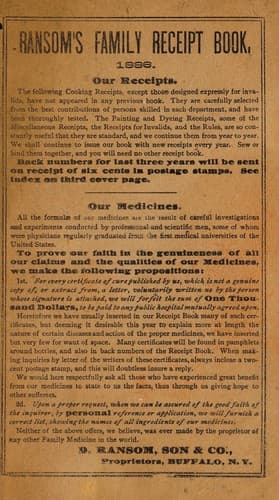
Ransom's Family Receipt Book (1886) is a promotional cookbook issued by D. Ransom, Son & Co, a Buffalo, New York patent medicine firm. Like many trade cookbooks of its era, it blends everyday domestic recipes with advertising for the company's proprietary remedies, chiefly Trask's Magnetic Ointment and King of the Blood. Readers will find soups, meats, pies, puddings, breads, cakes, preserves, and pickles alongside testimonials for treating ailments such as rheumatism, piles, scrofula, and weak lungs. A distinct thread of invalid cookery, including broths, gruels, beef tea, and calves-foot jelly, reflects the period's practice of treating food as medicine for the sick. The book closes with practical household reference material: weights and measures, land and hay measurement, painting and whitewashing instructions, and dyeing techniques for silks, woolens, and cotton. This combination of cookery, medicine, and household trades knowledge illustrates how commercial cookbooks of the 1880s doubled as advertising vehicles while still serving as genuinely useful domestic manuals. Modern readers approach it as both a culinary artifact and a window into patent medicine marketing of the period.
The book is organized into three sections that move from general cookery to invalid care to household reference. Section 1 opens with soups, meats, entrees, and a long run of pies and puddings, interspersed with medical testimonials. Section 2 continues with breads, breakfast items, cakes, preserves, and pickles, while introducing recipes aimed at feeding the sick alongside more advertising. Section 3 shifts decisively toward sickroom recipes and blood remedies before ending with practical tables and trade instructions for measuring land and hay, painting, whitewashing, and dyeing fabrics.
Recipes from this book
74 records extracted from the text, showing the first 50 in reading order. Each links to a modern interpretation.
Read the book
30 readable pages. A dot marks pages with recipe records.