
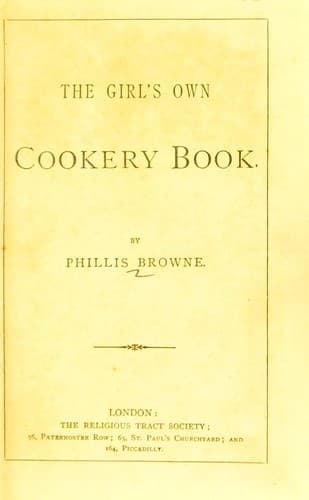
The girl's own cookery book
1882Phillis Browne · 108 readable pages · 98 recipe records · general household cookery book
From the librarian's dossier · AI-generated, grounded in the scanned text
The Girl's Own Cookery Book (1882) by Phillis Browne is a Victorian instructional cookbook aimed at middle-class girls, intended to teach the principles of cooking rather than simply supply recipes to follow blindly. Framed with a prefatory endorsement from a physician, the book positions cookery as both a domestic skill and a moral duty, one that equips young women to manage households economically and to prepare food for the poor and sick. Browne systematically walks the reader through fundamental cooking methods, roasting, boiling, baking, frying, and broiling, before moving into puddings, soufflés, pastry, soups, vegetables, fish, sauces, creams, and jellies. Later sections turn to specialized cookery for invalids and for the poor, followed by guidance on tea, coffee, and a substantial breakfast repertoire. Throughout, the author explains the scientific reasoning behind techniques, such as albumen coagulation in boiling meat, alongside practical economy, showing how to stretch cheap cuts and simple ingredients into nourishing meals. The book closes with an index. Modern readers will find a document that is as much a social and moral guide to household management as a recipe collection, reflecting the domestic expectations placed on Victorian girls and the class-conscious charitable ethos of the era.
The book proceeds from general cooking methods to specific dish categories. It opens with prefatory material and an introduction (section 1), then covers core techniques: roasting, boiling, baking, frying, and broiling (sections 1-2). It then moves into puddings, soufflés, and pastry (section 3), followed by soups and vegetable cookery (sections 5-6), fish preparation and sauces (sections 6-7), creams and jellies (sections 7-8), and specialized cookery for invalids and for the poor (sections 8-10). The final sections address tea, coffee, and breakfast dishes, concluding with a comprehensive index (sections 10-11). Numbered chapter markers (such as VIII and XVIII) appear within the headings, suggesting the original book used a continuous roman-numeral chapter scheme that the section summaries only partially preserve.
Recipes from this book
98 records extracted from the text, showing the first 50 in reading order. Each links to a modern interpretation.
Read the book
108 readable pages. A dot marks pages with recipe records.